

Welcome to Words with Wynn! If this is your first time perusing my content and you’d like more of my weekly musings, subscribe below:
Man has been imagining the future of farming since the agricultural revolution. For as long as he’s had to break his back toiling away in the fields, mankind has been pushing the limitations of nature’s bounty. More for less, by any means necessary. What if we rotated crops? What if we used fertilizer? How can we escape the whims of the gods- the heat, the cold, the drought, the blight, the pests- in securing our harvest?
Given humanity’s propensity to multiply like rabbits, food security has been an ever-present concern for most of the global population throughout history. Agriculture has undergone its fair share of revolutions along the way, each pushing food production out just ahead of our exponentially growing mouths to feed:
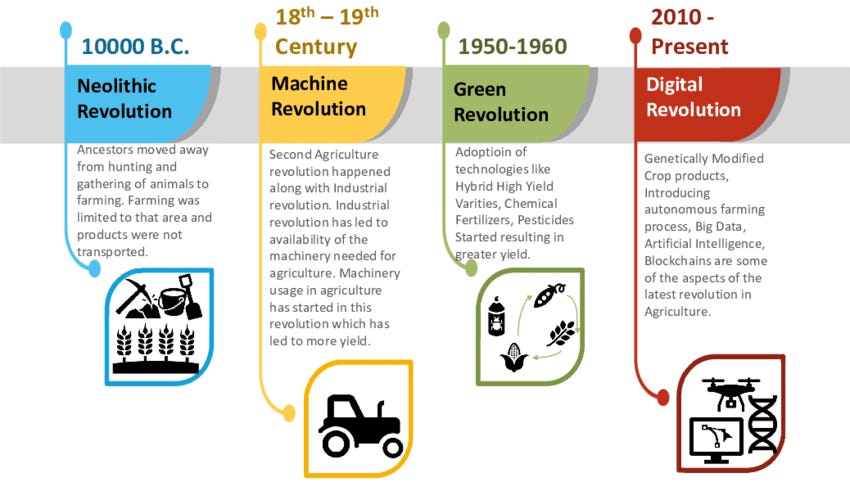
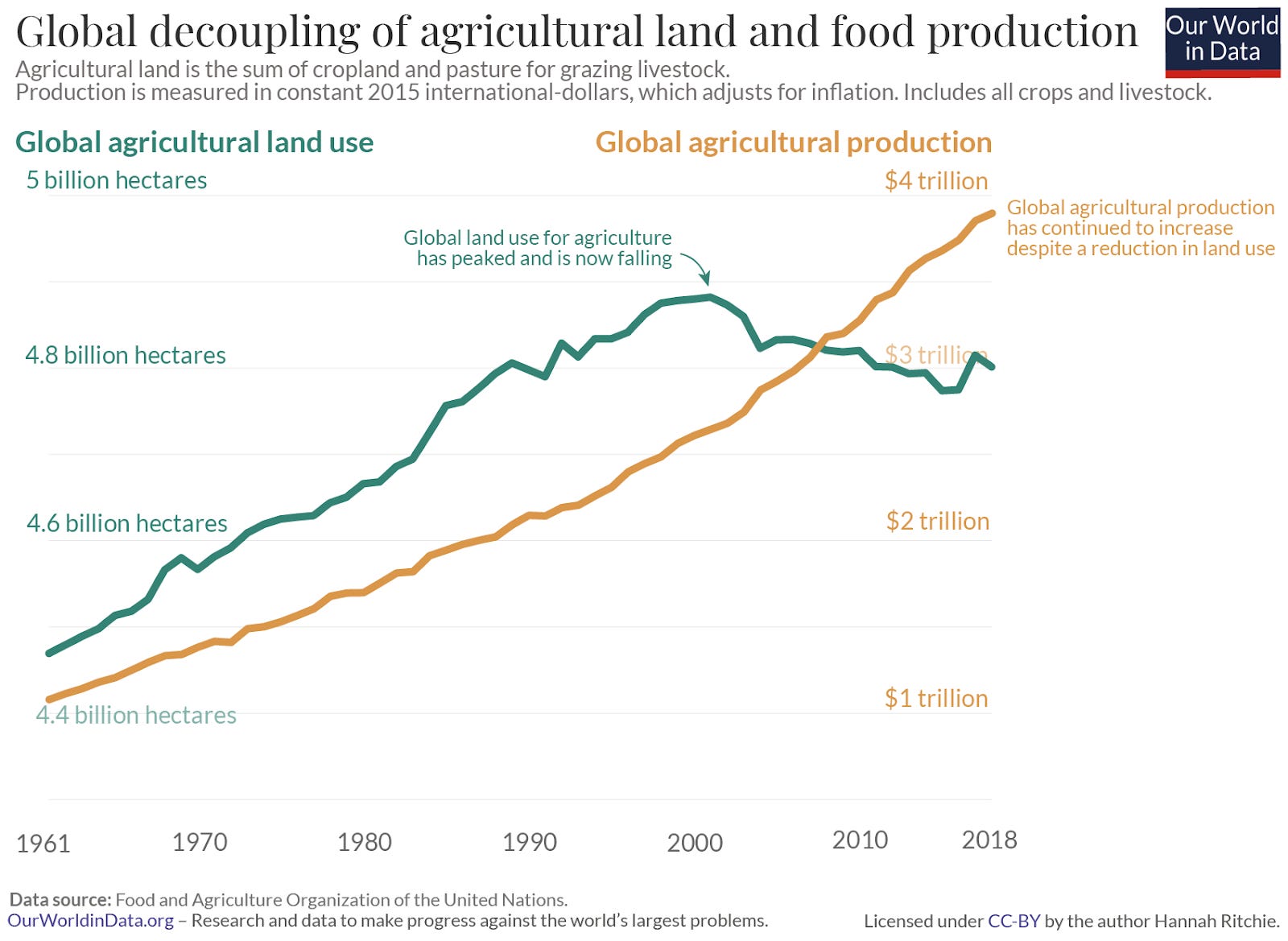
We’ve gone from planting seeds by hand to reaping with mechanized beasts, all the way through playing god and editing DNA. With each turn of the screw, humanity has been able to eke out more crops per square foot, bolstered by the expansion of arable acreage. But for how long?
Nature has limitations. Although we’ve mastered biology so far, there are pressing concerns when it comes to food security. If not topsoil degradation, then water constraints or limitations simply on available land:
A number of solutions are pushing the boundaries of how we exploit the earth to keep our bellies full. Some like Rainmaker are betting that altering the weather will end droughts. Others are working with biology and chemistry to optimize GMOs and fertilizers. The jury’s still out on Rainmaker, and the proof has been in the pudding for our biological approaches, but another major front for innovation has been the perpetual mirage of upending our archaic agricultural processes altogether. A cyberpunk vision of scifi skyscrapers filled with greenery galore delivering precision foodstuffs with clockwork consistency. I’m talking, of course, about vertical farming.
Overview & History
Growing plants skyward is nothing new. People have been stacking greenery since the days of antiquity (see: Hanging Gardens of Bablyon), but our modern idea of vertical farming is largely attributed to Columbia University professor Dickson Despommier. In the late 90’s, he and his students were grappling with the problem of providing fresh food in dense urban environments like NYC and converged on the idea of skyscraper-scale farms. The promises of this revolutionary approach to agriculture were many: co-located food production, reduced waste, seasonal consistency, water efficiency, and the list goes on. The idea then picked up steam in the late aughts and early teens, driven by global warming fears and subsidized by low interest rates.
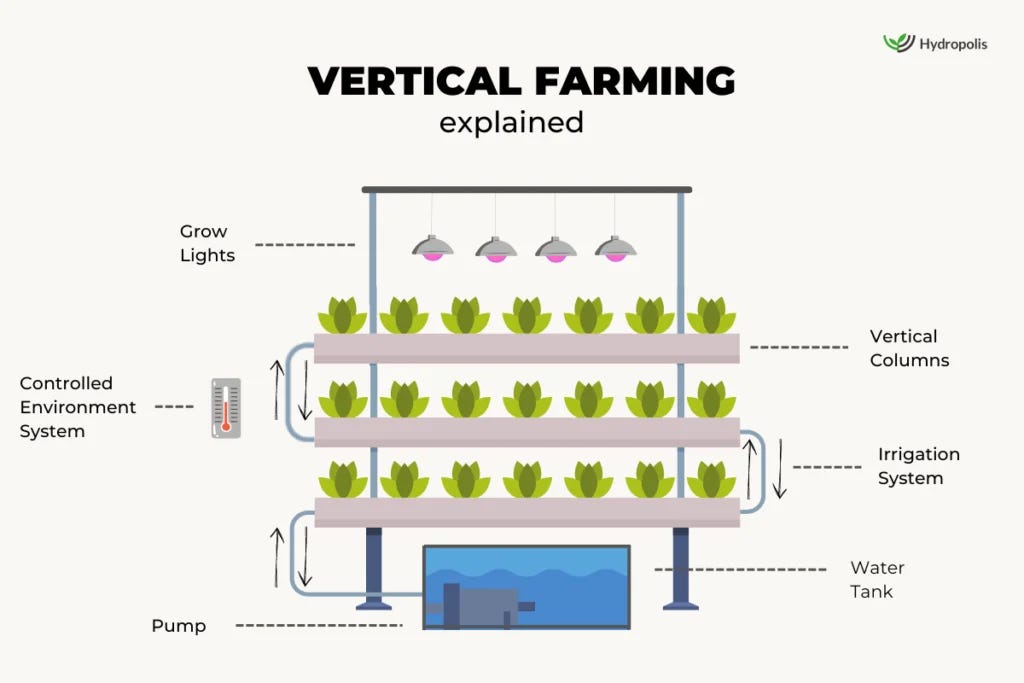
Modern vertical farming is the practice of growing crops in stackable, modular structures within a controlled environment, often leveraging soilless farming techniques. What this usually means in practice is giant warehouses with trays upon trays of vegetation, typically microgreens or berries, piled sky-high and illuminated by magenta LEDs. As opposed to greenhouses, which use some sunlight and are mildly climate controlled, vertical farms are sealed environments that control everything from light and temperature down to humidity and CO2 levels.
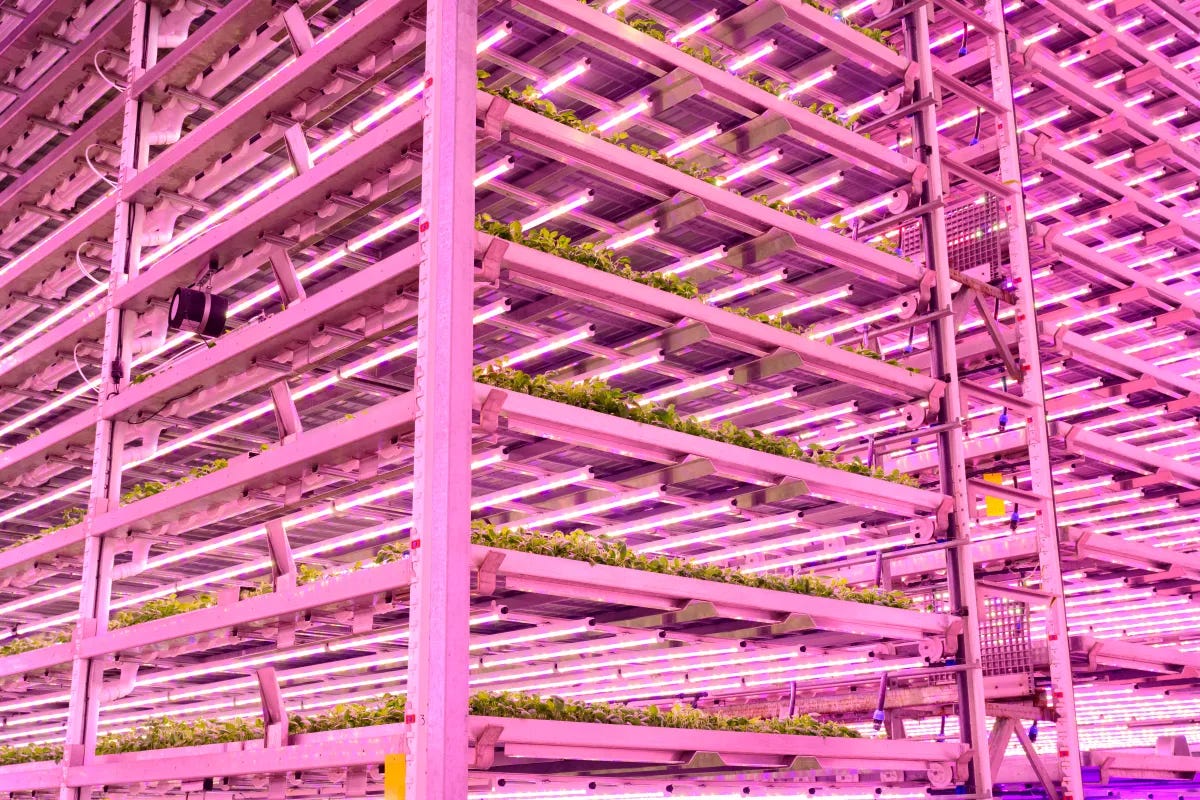
Theoretically, the advantages are many:
Resource Efficiency: Most vertical farms use hydroponics, growing their crops in mineral rich water solutions (soilless) that deliver nutrients and oxygen directly to the plants’ roots. These systems can reduce water use vs. traditional ag by up to 90% by eliminating run off and recirculating water as it flows down the stacked trays.
Production Consistency: Crops can be grown year-round, regardless of season and climate. Plants like spinach can produce as many as 12 harvests vs. 1-2 traditionally.
Improved yields: Precise control of inputs (cutting edge HVAC systems, elevated CO2 levels, regulated watering and nutrients) in conjunction with the density of the building footprints can produce up to 40x more food per square meter* than traditional farms.
Inherently Organic: Sealed growing environments allow farms to produce their crops without using pesticides, which reduces health concerns as well as pollution and run-off externalities.
Co-Location: Vertical farms can be constructed significantly closer to urban centers, thus optimizing supply chains to reduce food waste in transit as well as refrigerated transportation costs.
*Figures vary widely by crop type, etc. But most quote orders of magnitude more production per unit of land, with some like Wheat potentially producing hundred fold improvements.
It’s the holy grail of food resilience.
So, why hasn’t it worked?
Why Hasn’t It Worked?
Vertical farming is kinda like nuclear fusion - the tech’s been ‘just five years out’ for twenty years and counting. It’s a classic venture capital bull trap. Every few years, investors find it interesting, everyone gets hyped about the promise, and then mountains of capital proceed to be torched in an attempt to will farms of the future into existence:
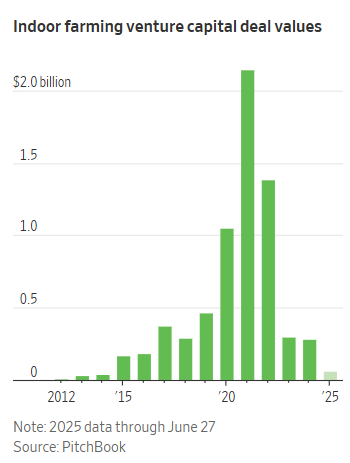
The most recent cycle of vertical farming startups received boatloads of investment in the last decade, with everyone from Bill Gates and Jeff Bezos to leading VCs like General Catalyst and Tiger Global backing up the truck. The promise was great and the money was cheap. The green wave and environmental fears were in full effect, then global supply chains were rocked by COVID and suddenly food resilience was the topic of the hour. The valuations grew along with the produce. The future was here!
Then reality caught up.

Vertical Farming could be pointed to as a ZIRP poster-child. When the money was cheap, it flooded into a capital intensive sector that offered great promise. The biggest names like Plenty, Appharvest, and Bowery Farming each raised hundreds of millions of dollars to sprout vertical farms across the globe, but scaled facilities before their business models were fundamentally sound. In classic Silicon Valley fashion, it was easy to grow when you were selling a dollar for $0.75, subsidizing every head of lettuce with hundreds of venture dollars.
The primary challenge was ultimately cost structure.
On the front end, you’re outfitting state of the art facilities with precision growing equipment, attempting to leverage autonomy as much as possible. This requires massive capital expenditures. For context, industry estimates from a SPAC’d Canadian vertical farmer (Beyond Farming - now Sprout AI. Because, of course) put capex costs per m³ of growing space to have significantly exceeded $3/m³ for some of the largest farms in the last cycle:
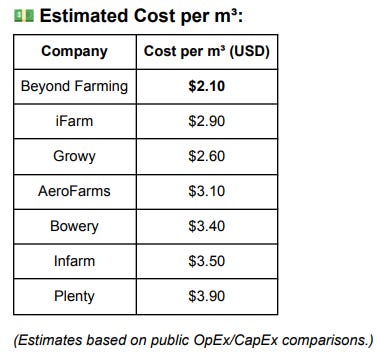
This vs. tax advantaged Kansas ag acreage that might run you $1.43 per square meter (~$5,800 per acre). Not really apples to oranges, ignoring equipment costs etc. for traditional farmland, but you get what I mean.
So, you’re starting deep in the hole just to get your racks off the ground, but then what really kills you are operating expenses. Namely, power.
Farming is an energy intensive business in its own right, but that’s fine when you have the world’s most powerful generator (the sun) free for your plants and just need a little diesel to fuel your tractor.. Once you enclose the space and have to light every hour of the growth cycle, 24/7/365, with high-end LEDs, the cost of power begins to become prohibitive. You load on top of this the ongoing power demands of an incredibly sophisticated HVAC system which is regulating humidity levels and temperature with high precision. Not to mention your ever-circulating irrigation system. Then you swap cheap migrant labor for sophisticated, high dollar robots and engineers, and pray you can automate your way to efficiency at scale. Tough.
Lighting and climate control are the real killers:
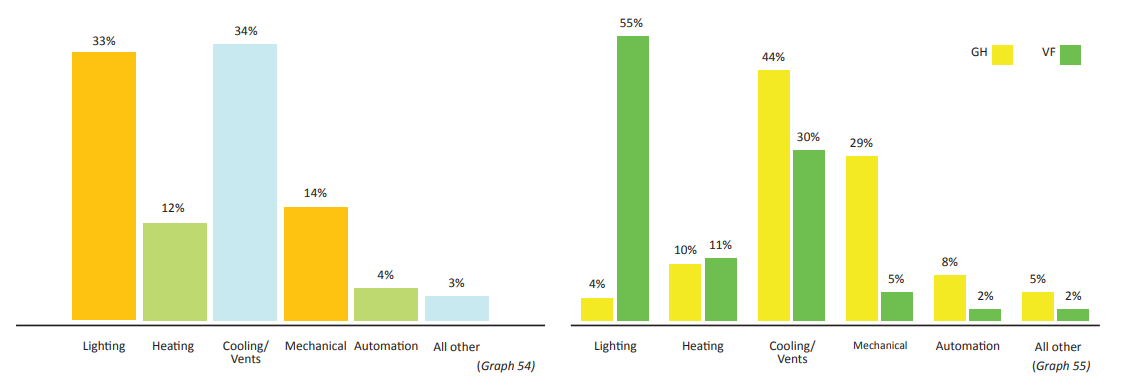
It’s a bit of a compounding problem too – you’re keeping rows upon rows of crops illuminated around the clock, but the bulbs themselves are producing heat which your HVAC system has to dissipate in order to maintain ideal temperatures. That’s in addition to combatting external temperatures, which can be particularly problematic as the most attractive locations for vertical farms tend to be the farthest from existing farmlands (ie: less moderate climates).
This translates to expensive crops:
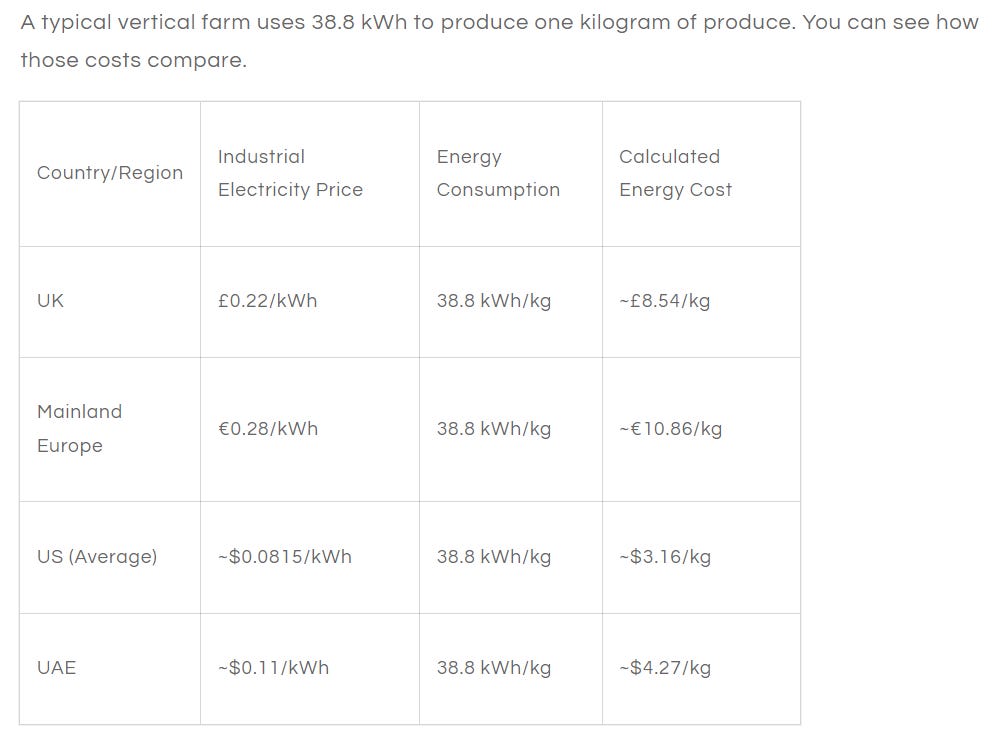
You simply can’t deliver a cost competitive head of lettuce for $2 when the energy alone to produce it is bleeding you $3.16.
Then there’s a challenge in the product itself.
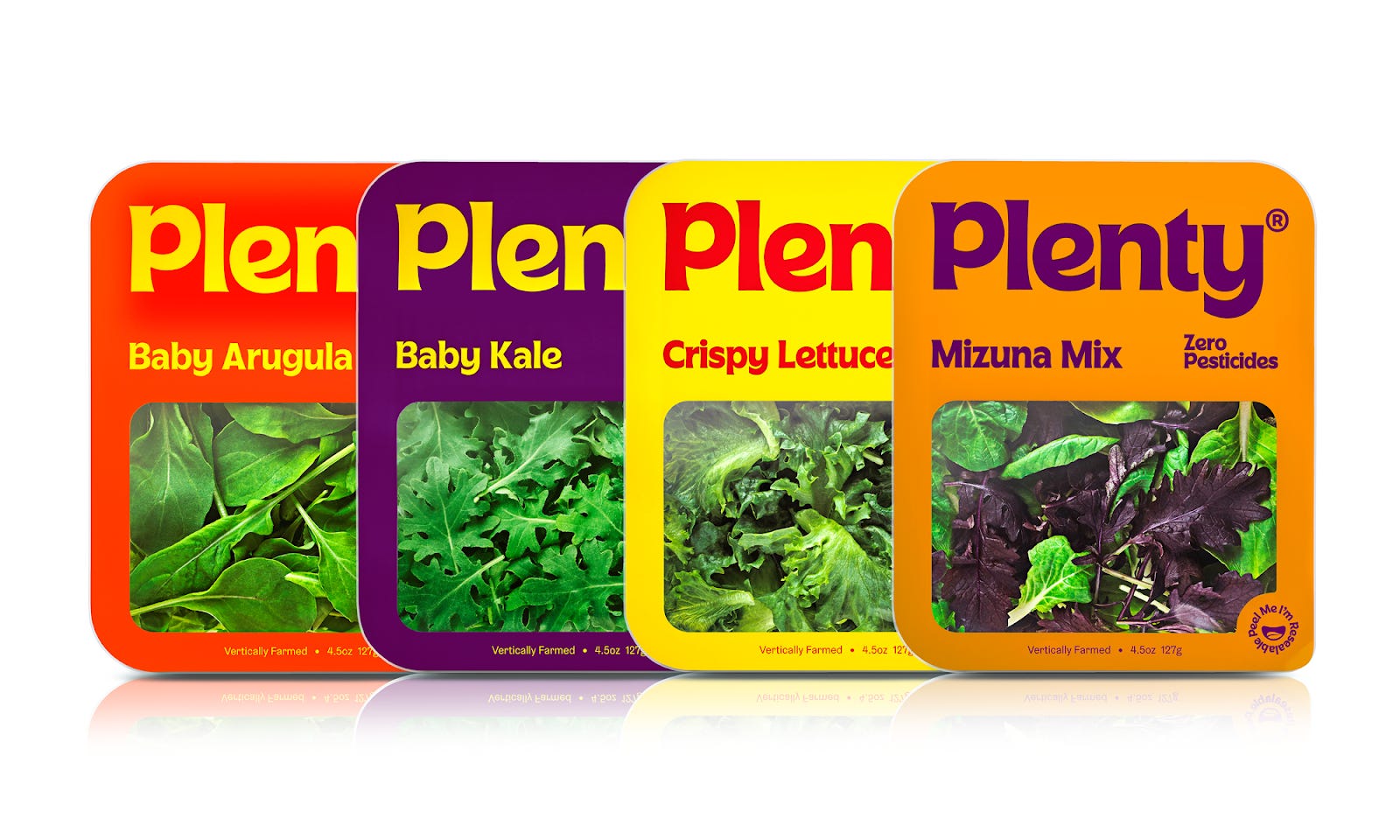
You’re producing produce.
These startups were selling an undifferentiated product to an extremely price sensitive consumer in an arena where brand name means nothing. A carrot is a carrot is a carrot. So, although you can achieve massive production gains in some crops like wheat (up to 200x in some studies!), this simply doesn’t cut it when it’s so cheap to produce the old fashioned way. Crops like cereals tend to be extremely low margin as is, and are often subsidized by governments to ensure their production.
Hence, companies tested different products and largely converged on higher margin, space efficient crops like microgreens or berries. A particularly interesting example of this is Oishii, which began with its Omakase Japanese Strawberries. These berries promise a more vibrant flavor and texture than their industrially grown counterparts. The startup’s initial product found favor with elite restaurants with deeper pocketbooks who were willing to pay up for consistent product on a consistent timeframe, and Oishii has since expanded its product portfolio to other berries and even tomatoes. This Tesla Roadster-like strategy, starting at the high end with a differentiated product and moving down the curve with scale, seems to have worked better than many of Oishii’s restructured competitors who went directly after commodity markets like lettuce or spinach.
The industry has stabilized on the back of its mass extinction event of the last few years. The remaining players have slashed their footprints, tightened their product focus, and right-sized their balance sheets for the most part. Given the state of play today, with vertical farming representing a miniscule piece of our global food production, it made me wonder: were the investors wrong or early?
Could This Time Be Different?
Vertical farming could be a textbook example of the Gartner Hype Cycle:
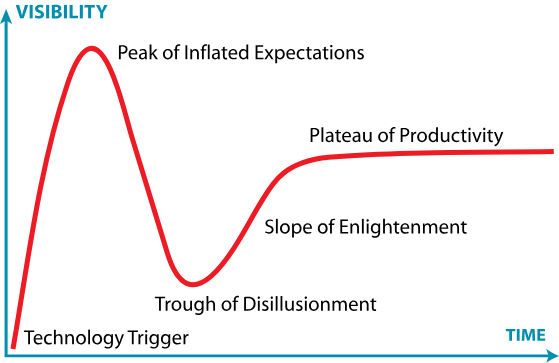
There was much promise, a massive wash out, and now I’m left speculating whether the sector might be entering its slope of enlightenment. “This time it’s different” are said to be the four most dangerous words in finance, but a few factors lead me to think we could be ripe for a breakout.
LED & HVAC Costs:
Light-emitting diodes (LEDs) are the most common type of lightbulb today, and have continued steadily marching down the cost curve since vertical farms were first getting attention in the late aughts. LEDs have followed their own version of Moore’s Law called Haitz’s Law, which states: “... that every decade, the cost per lumen (unit of useful light emitted) falls by a factor of 10, and the amount of light generated per LED package increases by a factor of 20, for a given wavelength (color) of light.”
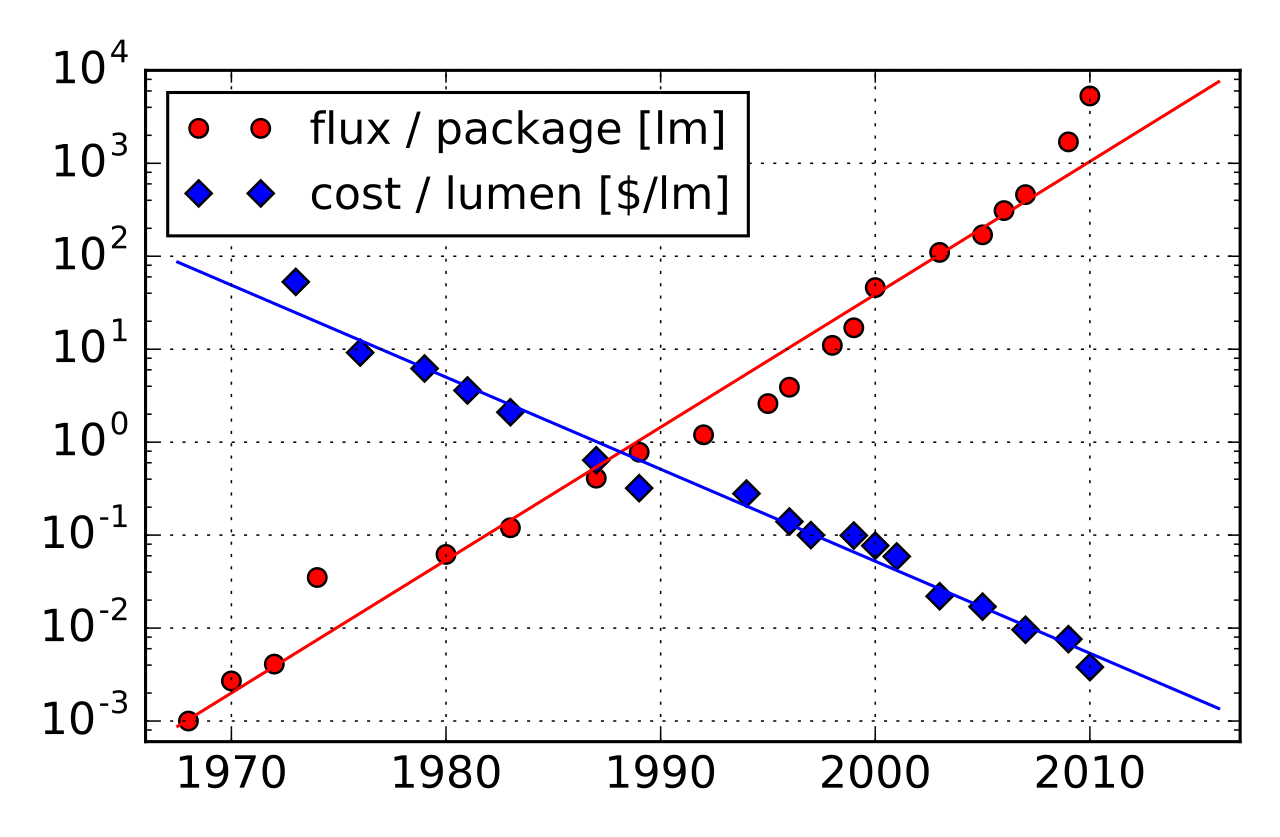
LEDs have massively improved over the last decade. By 2030, they’re projected to have improved their efficacy (lumens per watt - energy efficiency) by ~90% from 2010. This was occurring concurrently to the average retail price falling precipitously:
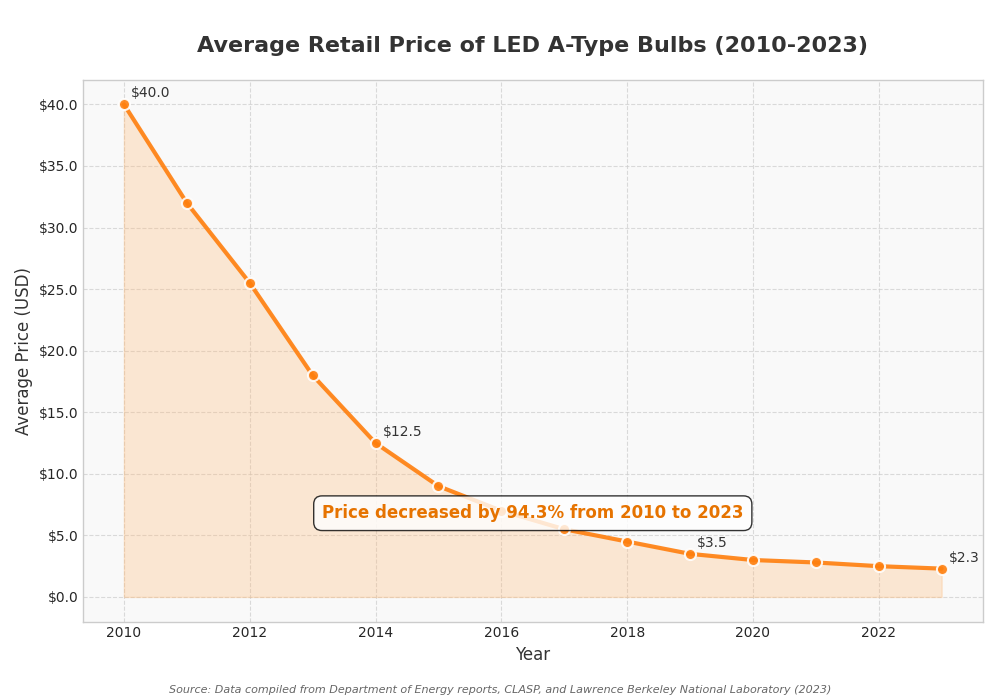
These efficiencies could compound as they’d reduce upfront capex initially, and also improve ongoing energy costs on the HVAC side with their reduced heat output.
Unfortunately, on the latter side of that equation, HVAC systems are still largely physics constrained as vertical farming requires energy intensive dehumidification processes which don’t seem to have experienced the same step-change improvements in the last decade.
Robotics, Sensors, Intelligence
Similarly, while the vast majority of vertical farms were getting wrecked by their expensive cost structures, the requisite components of automation continued to advance. Robotics has made leaps and bounds in both quality and cost of computer vision systems, the types of which are needed to monitor your crops, as well as the general automation needed for planting, picking, and other activities within your warehouse.
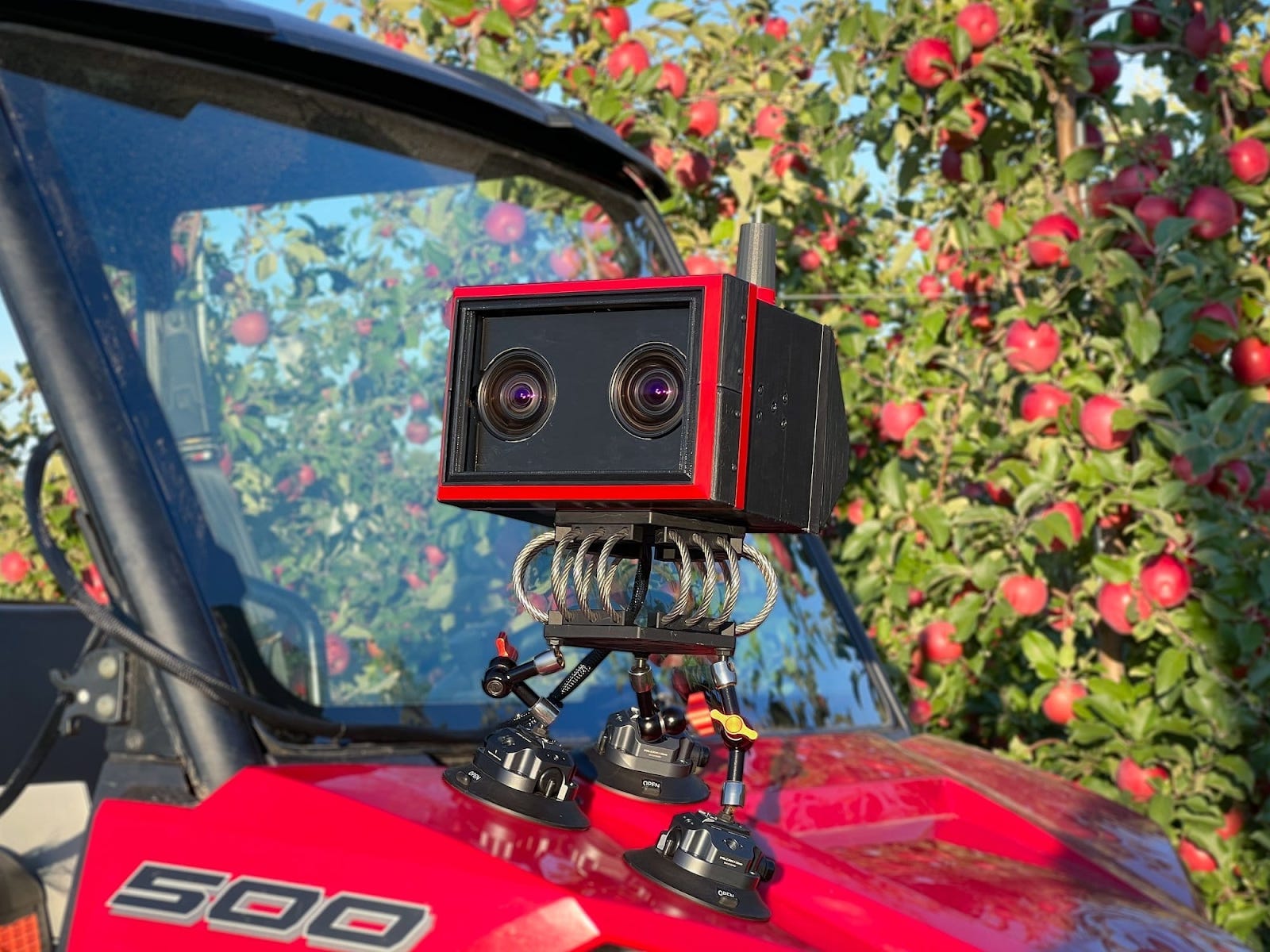
Orchard AI is a prime example of these kinds of breakthroughs applied to the ag space already. They’ve invented a tractor-mountable camera system with the ability to capture 100 images per second, recording data about every fruit on every tree within a farmer’s orchard. Placing hardware with that level of fidelity (camera quality, edge compute) at an attractive price point to farmers was an economic impossibility a decade ago, let alone processing the terabytes of images at scale on the back end. These same hardware improvements and AI capabilities could translate back into the controlled environment agriculture arena as well.
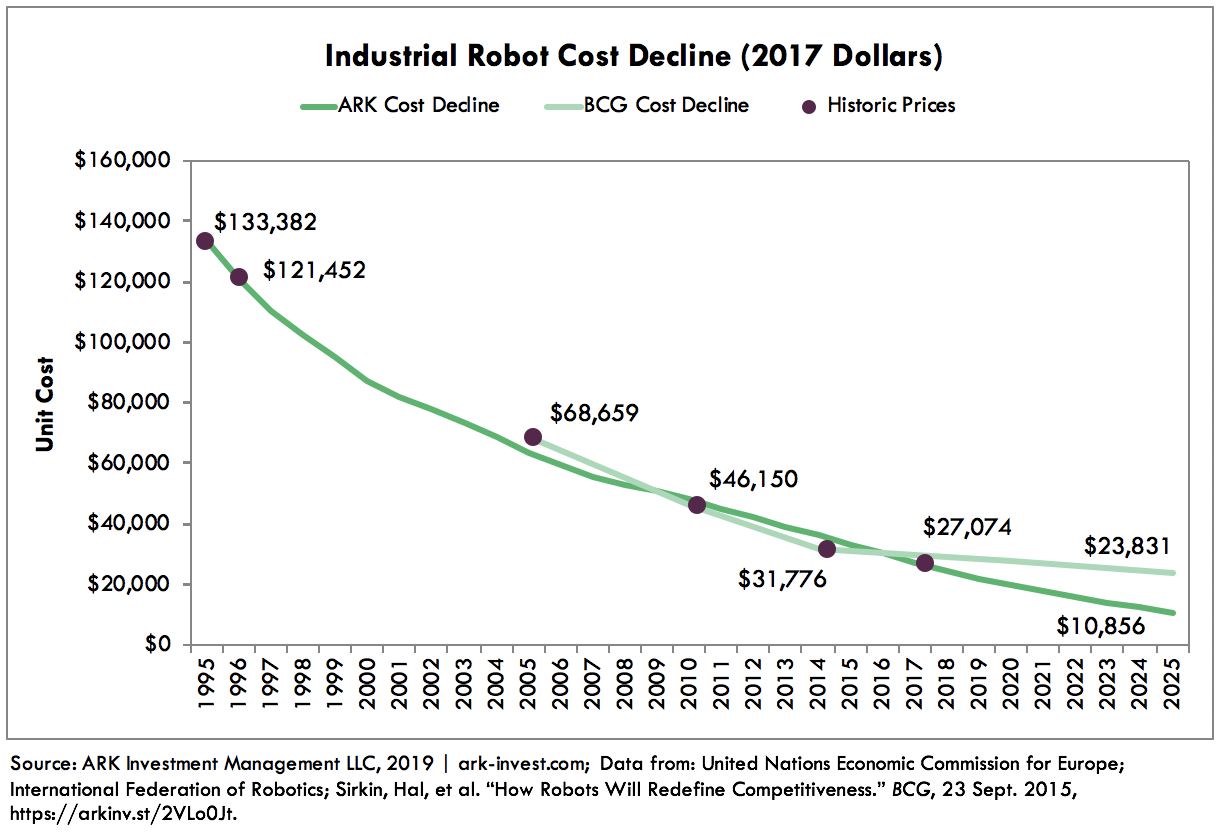
On the labor automation front, we’ve also seen strides. ‘Embodied intelligence’ has become all the rage as investors seek the next leg up of the artificial intelligence boom, and those investments have driven costs down rapidly:
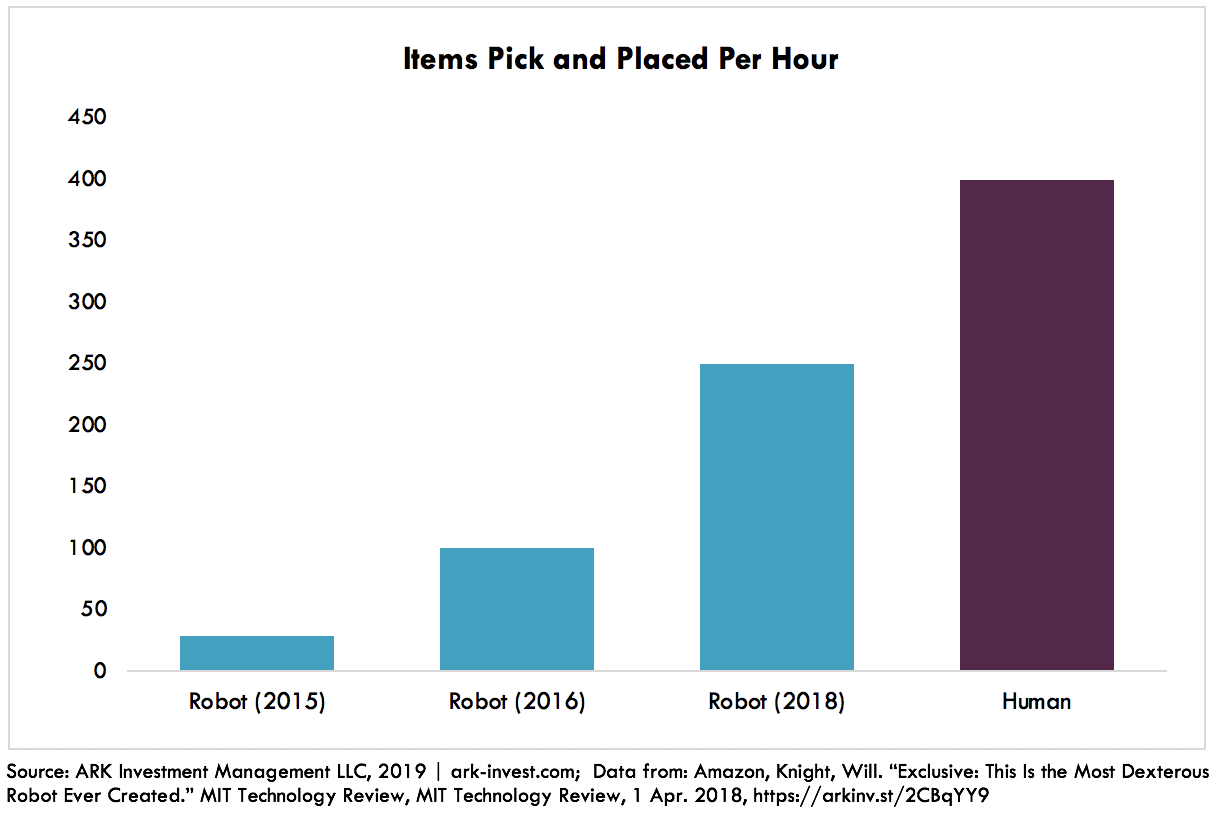
Simultaneously, dexterity has continued to improve (much needed to pick delicate little berries):
These two components alone have made me wonder if a blank slate startup, unbound by technical debt like existing incumbents, could sidestep some of the pitfalls of the previous generation and chart a more expedient path to scaled profitability.
Unfortunately though, physics is undefeated and the largest cost driver seems to be going against you.
Energy:
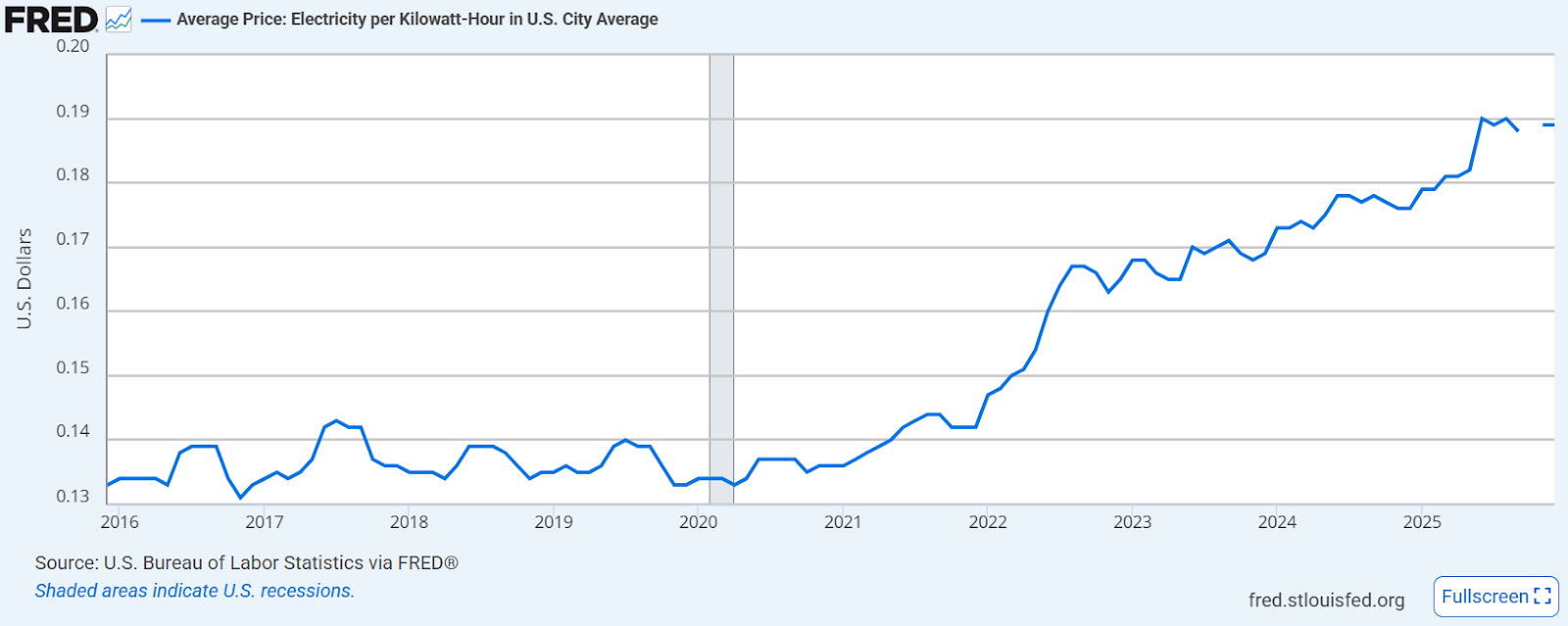
Energy prices continue to climb. Feeding the insatiable appetite of our digital gigabrians has come at the cost of maxing our grid and squeezing our pocketbooks. This is a particularly thorny problem if you’re a vertical farm and your primary cost driver is the price of a kilowatt.
The irony of this challenge is that it’s precisely what led me to explore vertical farming in the first place. I’ve been contemplating the second order effects of energy superabundance. My thinking gets speculative here, but allow me to explain.
I previously wrote about the race to ooch our way up the Kardeshev Scale, and master energy on a societal scale. Well, now it really feels like we’ve undergone a generational vibe shift with regard to power production. Across the aisle, there has been unanimous recognition of its underlying importance in our competition with China, and how sorely we’re losing that race:
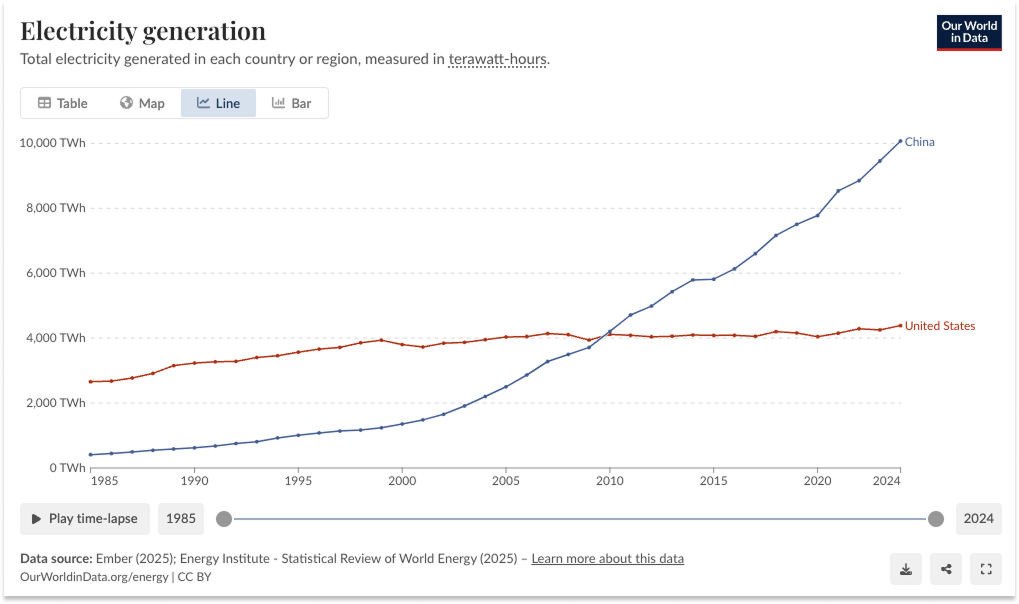
These economic and competitive pressures have catalyzed a number of bold policy moves. Everything from abducting heads of state to accelerating the nuclear renaissance. Done responsibly, dramatically increasing America’s energy generation is a net positive for our society. That said, the types of investments that actually make a dent are extremely capital intensive and extremely long-dated. Even with the SMR race to reach Criticality by 2026, home town heroes like Aalo still won’t actually be producing reactors at grid scale for a number of years.
Which leads me to believe that there’s a very real possibility that the AI revolution follows a similar pattern to the dotcom bubble with regard to infrastructural overbuilding.
The Dotcom boom pulled insane amounts of investment into telecom infrastructure, which was subsequently underutilized and crushed the sector as internet demand fell off when the bubble burst. Similarly, I think that a breakthrough in pre-/post- training efficiency or chip architecture on the AI front (and/or any other black swan into the trough of disillusionment) could potentially leave the U.S. in a place where we’ve massively overbuilt power infrastructure. Given the titanic nature of these types of projects, it could easily result in a long period of very cheap energy.
By way of example, average U.S. and Chinese industrial energy pricing today sits around 8-9¢/kWh, and then startups like Aalo are ambitiously targeting sub-3¢/kWh:
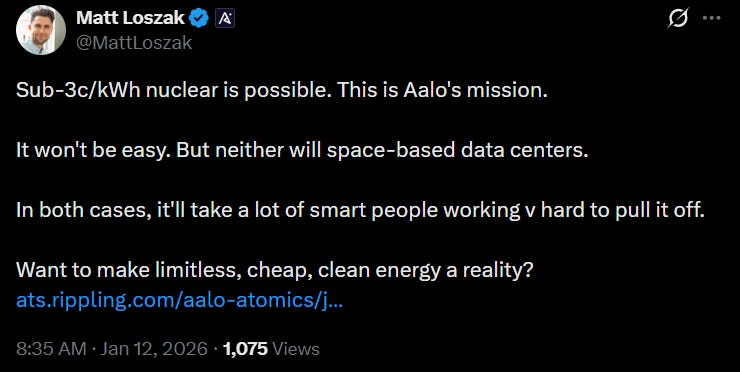


It’s possible that a vertical farming startup founded in 2026 could be reaching scale just as energy prices are falling off a cliff. A wave of cheaper supply coming online concurrent to declining demand could be a great place for a vertical farm to flourish.
Again, speculative but not crazy.
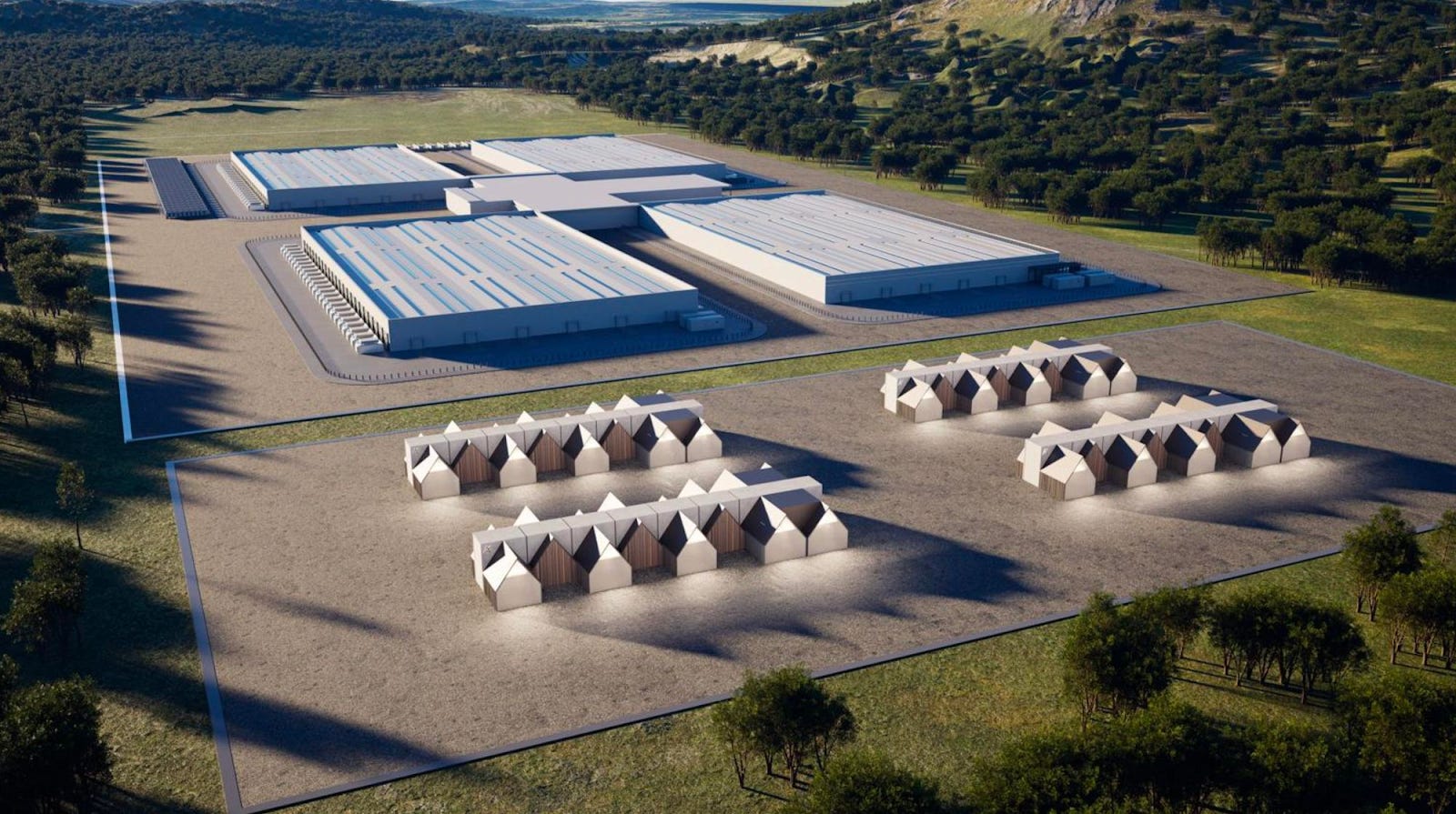
My other scifi thought was really the colocation of SMRs with vertical farms following the same logic we’re applying to datacenters. If ever there were a piece of infrastructure that needed steady baseload power, a consistently humming vertical farm could very much be it.
Conclusion
Vertical farming seems like an interesting, out of favor sector that could potentially produce a venture scale winner. A generation of investors have been burnt by its prospects, and hence the pricing could be particularly attractive on the right deal. Perhaps there’s a contrarian take where the cost physics have shifted beneath the industry’s feet in such a way that a winner could bloom at scale.
History doesn’t repeat itself, but it does often rhyme. Pets.com is frequently named in the same breath as dotcom exuberance, yet the explosion of the internet gave way to unicorn Chewy not ten years later. Same shit, different decades. Perhaps vertical farming could be the ZIRP era equivalent.
But hey, maybe the food problem works itself out, regardless. Perhaps population collapse really is imminent and the Cassandras out in the Valley prove to be right. Were that the case, I still see this technology as a relevant component of domestic food security in an increasingly isolationist geopolitical world.
Plus, how else does Elon think we’re going to grow all that food on Mars?
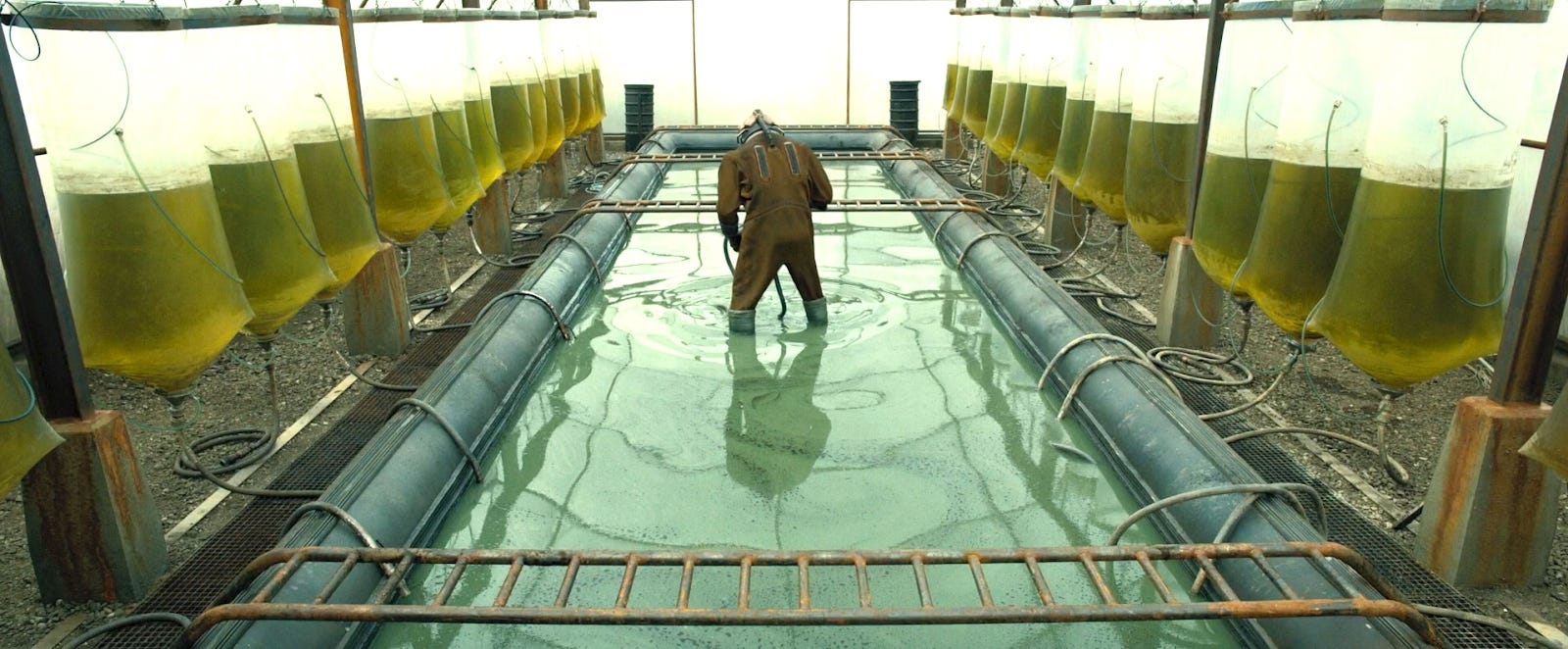
I’ve seen Bladerunner. Grub greenhouses and vertical farms.
- 🍋
P.S. Big thanks to Jack Oslan, a Co-Founder of Plenty, for graciously talking Vertical Farming with me for a couple of hours.