

Welcome to Words with Wynn!
If you’d like more of my weekly musings, subscribe below:
A year ago, I wrote a little riff: Spotif[AI] Between a Rock & a Hard Place.
I was mulling over the incoming onslaught of generative music, and I thought that Spotify was in a tough spot. My logic was more or less as follows:
Integrating AI-generated music, either from users or generated from a subscriber’s taste, would help shield Spotify from disruption
But they couldn’t do this because it would alienate the core of the business model (artist revolt, copyright questions, etc.)
So, they’d be forced into a structural position where they’d have to wait for disruption and then overpay for whichever startup started to hit as the zeitgeist became more amenable to AI creation and/or generative music
Hence, they didn’t have a great wedge for AI, and had only really launched some lackluster features (AI DJ, thumbnail image generation, etc.)
The piece was a five minute blast about one aspect of Spotify’s business, but I really underappreciated a couple of things.
First, the value of music as a cultural and collective experience. Sure, there will be some generative music, and we’ll get a huge AI artist sooner or later, but the value of these things to the consumer is the shared access to music we all love. Maybe I’m happy to have my elevator music personally generated on the fly for when I’m working, but the bands I adore are usually linked to experiences with others and the joy of sharing great tracks. Second, it overlooked the other ways that AI stands to enhance Spotify’s business and actually strengthen its moat.
My original framing came through the lens of music creation. I’d been writing about platforms like Roblox and the vibe coding startups, and how consumer technology broadly arcs toward accessibility. Roblox allowed anyone to create games, Uber gave everyone a personal driver, and Ableton allowed a kid in his bedroom to produce grammy caliber tracks. I took these ideas, and extrapolated to the music industry. Being a Spotify power user, I thought “Well, if there are far more creators, why wouldn’t you want to own that whole flow?” A bit of vertical integration a la Replit. Where vibe coding platforms own the creation and extract additional value through complementary services (hosting, deployment, etc.), Spotify could own the full stack from creation through distribution all in one place.
Kind of a fun idea, but misguided.
Spotify is an aggregator, and leveraging AI will serve as a sustaining innovation to their model more than a disruption. The change on the supply side actually serves to strengthen their position while simultaneously improving the value that the platform itself can create for consumers on the demand side as well.
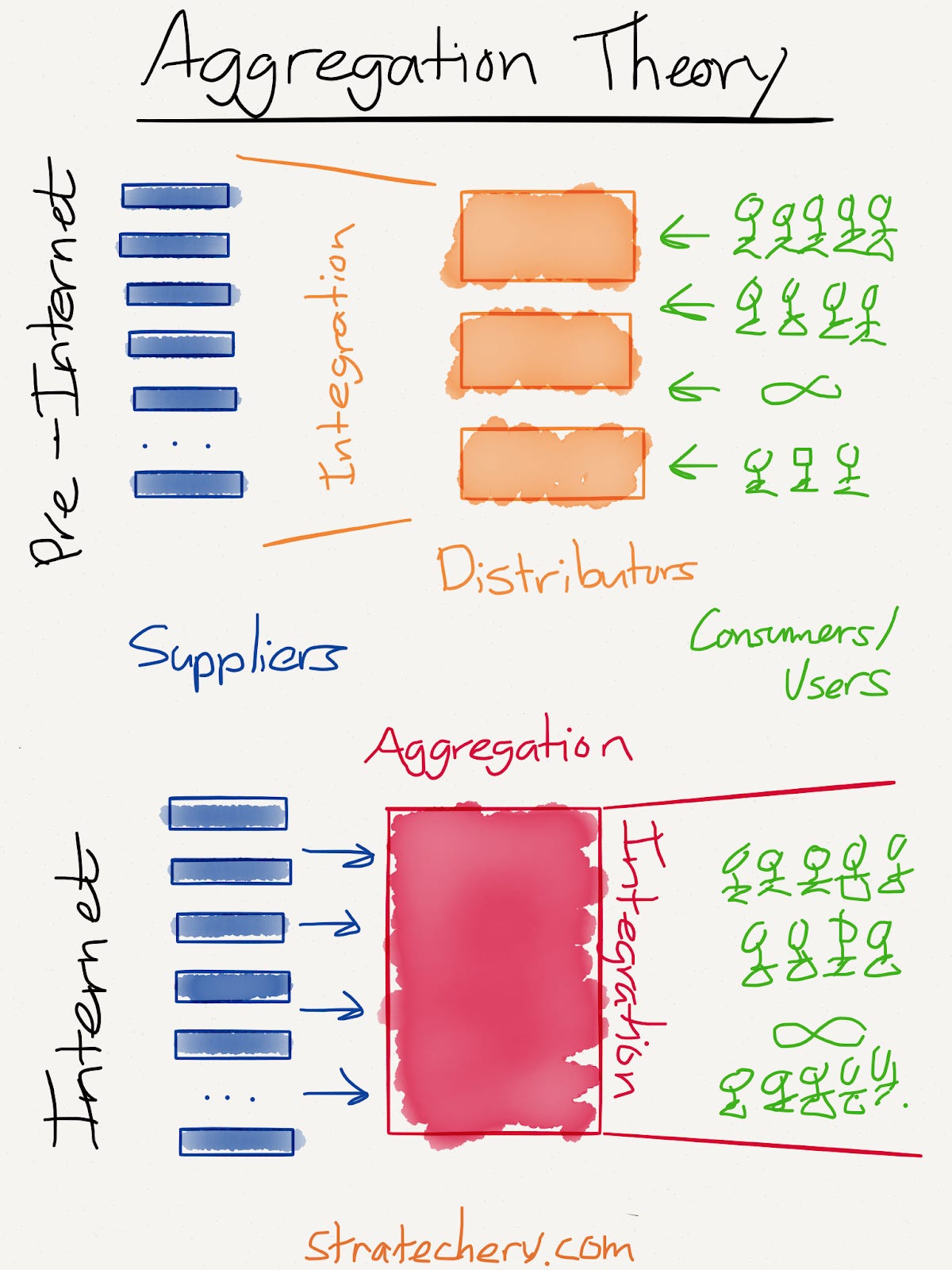
Daniel Ek’s brilliance founding Spotify was recognizing and solving the music industry bloodbath that internet piracy had created:
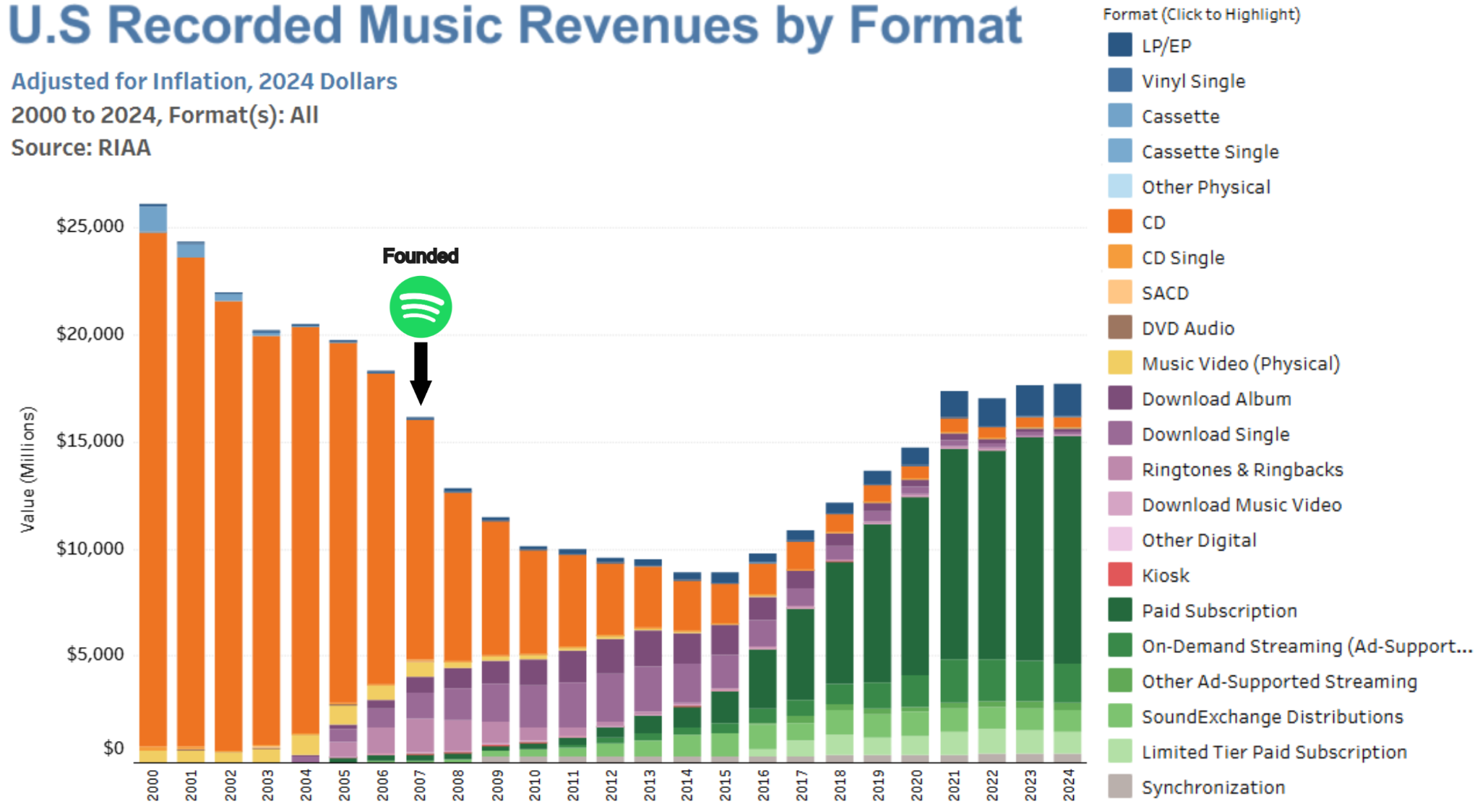
One of the core insights for aggregators of that era was the structural shift that internet-native business models created. Suddenly distributors could be squashed by whichever monolith controlled demand. In music’s case, there was a hair-on-fire problem where the internet suddenly upended your packaging and distribution monopoly (CDs, supply chain, radio broadcasting) without providing the guardrails to protect your IP (see: Napster, Limewire).
Spotify stepped in to aggregate the demand, yes, but it also had a unique opportunity to wrangle highly consolidated supply from just a few dominant record labels. Then, sitting in the middle, the supply side could be delivered through a frictionless enough user experience to make its simplicity more attractive than blowing up your family’s computer with Limewire. Amazing timing.
This seed of a service grew and grew and grew to where we are today. I’m not deep enough in the industry to debate the merits of artist compensation via Spotify/Apple’s duopoly, but I can say that they’ve empowered global distribution on a scale that would previously have been impossible for any but the largest artists. If you create a song in a weekend, you can have access to 751 million Spotify listeners around the globe on Monday.
But if you’re one of those 751 million users in 2026, why is Spotify so valuable?
Sure, a decade ago Spotify was the world’s audio library, but today that’s been semi-commoditized. I can go to Apple Music or Youtube and probably find 99% of what I’d need. Apple’s leaned a bit more into exclusives than Spotify (DJ sets and stuff), and Spotify’s locked down a few select podcasts (a boon for their margins, which are constantly squeezed by record labels)... But for all intents and purposes the difference is negligible for the vast majority of users.
What’s Spotify’s really got is Wrapped:
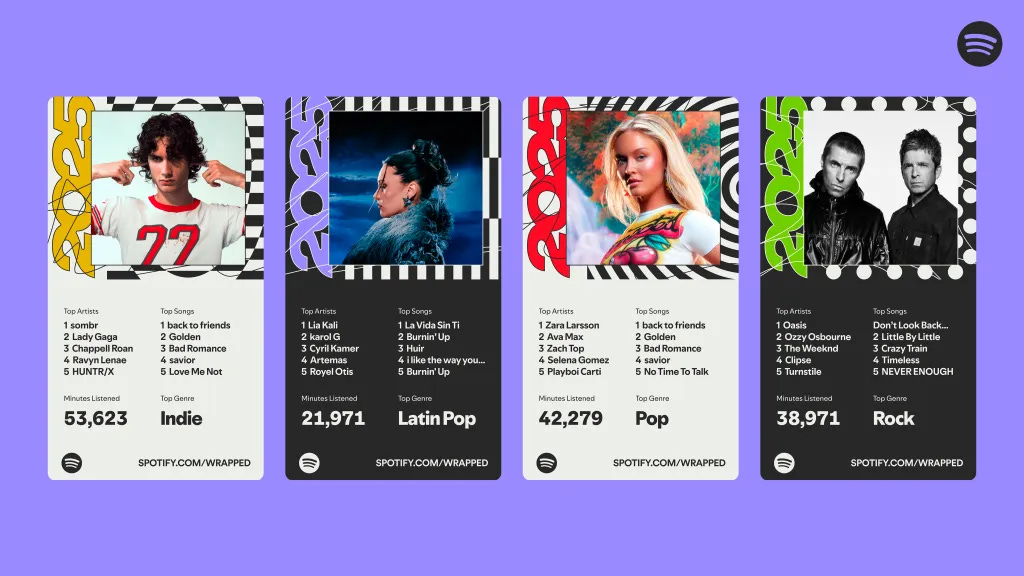
A little tongue in cheek, but what Wrapped really represents is the marketing manifestation of their uniquely massive data lake. Spotify knows what I like, when I listen, and how I’d like to discover new music. Spotify sits in my pocket as the aggregation and discernment layer for my musical experience, fortified with a decade of my personalized taste.
I think the scale of their user base and the depth of their data expands the company’s moat in the age of AI. And that was my mistake in examining AI-powered disruption for Spotify exclusively through the supply side.
What smacked me in the face was Ben Thompson’s simple analogy:
Spotify doesn’t sell guitars.
“In terms of net new music, there are tons of companies that allow you to create music using AI. But that’s not where the music breaks. That music, if it breaks on Spotify. That’s where charts, that’s where the culture moment is. So we feel very comfortable about that position.” - Söderström 4Q25 Earnings Call
72 months ago, the world was already awash in human-generated music slop. No Suno AI needed. The 1,000x explosion of UGC should really just benefit the platform, as they remain the source that knows me best and can feed me bangers accordingly.
I also underappreciated the opportunities with their current AI products:
“More recently, we also launched Prompted Playlist, a new tool that has instantly taken off with power users. So if Interactive DJ is the chat interface to Spotify, where you can talk casually, Prompted Playlist is the deep research mode of Spotify. It lets you describe and set rules for your own personalized playlists, literally writing your own algorithm. It taps into your entire Spotify listening history, reflecting not just current obsessions, but the full arc of your music taste and integrates up to the minute culture pulled from the Internet.” - Söderström, 4Q25 Earnings Call
I fell for a little trick that lots of normies experienced – I played with their AI twelve months ago, and it was rather lackluster. It’s like your uncle who tried ChatGPT two years back, and concluded that it was an error-ridden Google knock-off. But the rate at which these things improve continues to astound (see: playing with Replit even 6mo ago vs. today), and the value of these features can actually be extracted by Spotify with only a fraction of their user base trying them. The company can pull utilization and consumer patterns out from the power users, and use this data to inform the models that are driving discovery elsewhere.
Another non-obvious example of Spotify’s unique and massive dataset comes down to vibe curation. They’re able to tailor music in real-time to an ever-evolving cultural zeitgeist.
For example, consider workout music.
I hadn’t really thought about just how idiosyncratic and ephemeral something like workout music is. I’m a 1% power user of Spotify. I DJ occasionally. I like to think I have a deep obsession with the ✨vibe ✨ that music creates. And I kind of missed how hard it must be from a data perspective to dial in these intangible kind of ideas.
The definition of “workout playlist” is constantly evolving across different people, ages, cultures, and time periods in a way that Spotify is uniquely qualified to capitalize on. My taste for workout music today is different than yours today is different than mine a year ago. Yet Spotify generally nails it.
This is one of the elements where TikTok has been insanely powerful for me (see: TikTok’s Magical Mousetrap). Its ability to dial in your likes for the algorithm broadly, and surface bangers for me specifically is astounding. But TikTok remains a video-first platform with music intertwined, not the home of all audio the way Spotify aspires.
Sure, the platform will need to prepare for a deluge of AI music-slop, but that’s actually where they’re already great– teasing out the tracks that their users want to hear. They don’t sell guitars and they definitely don’t need to.

Anyway, I guess I’m long Spotify in the forthcoming slopmaggedon.
- 🍋