

Welcome to Words with Wynn!
If you’d like more of my musings, subscribe below:
Spotify Discover fed me a new DJ this week. Tiny little artist with fewer than 100K listens. Perfect kind of lounge house vibes that I love.
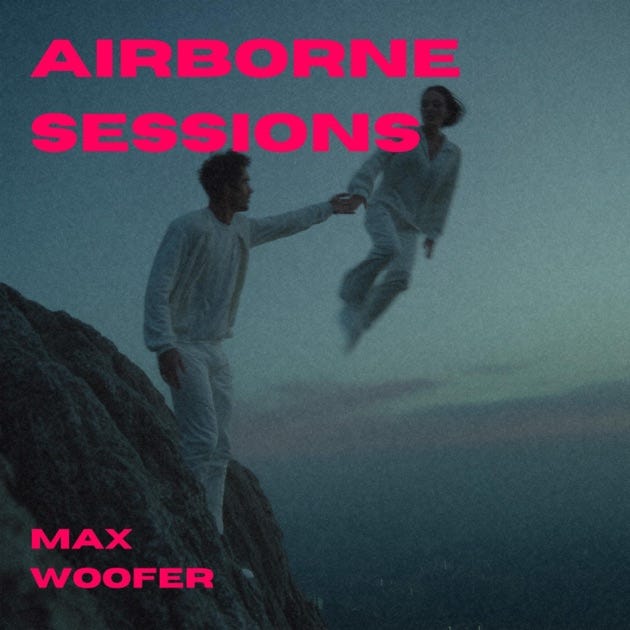
I was smitten. Hell yeah, a diamond in the rough.
So, of course, being the music nerd that I am, I start Googling to get to the bottom of who this no- name creator is. They’ve got a dozen tracks on Spotify, yet they’re a ghost online. No Instagram, no Twitter, nothing. The most I can find is their songs cross-listed on Apple Music and YouTube as well. Weird.
Equally peculiar, they’ve got like four albums in their catalogue, but they all seem to have been released in May of last year…
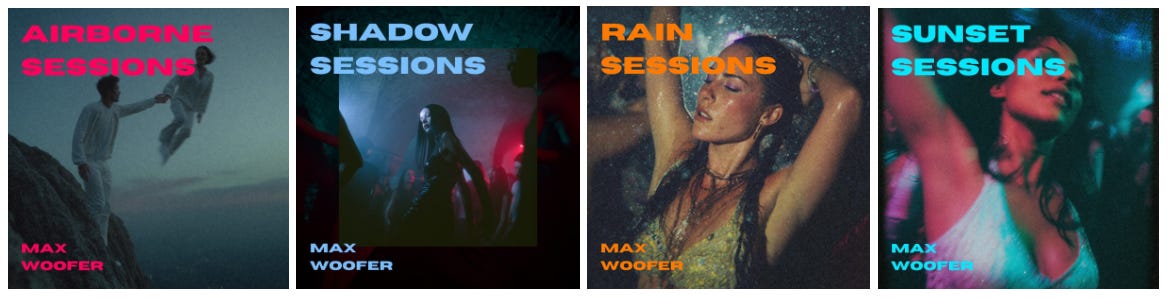
I dig a little deeper.
The single shred of evidence I find is a deleted, cross-posted Reddit link:

Oh no. No, no, no, no.
Here I am bopping to my new favorite DJ for six hours, and suddenly I look up to find myself face to face with this guy:
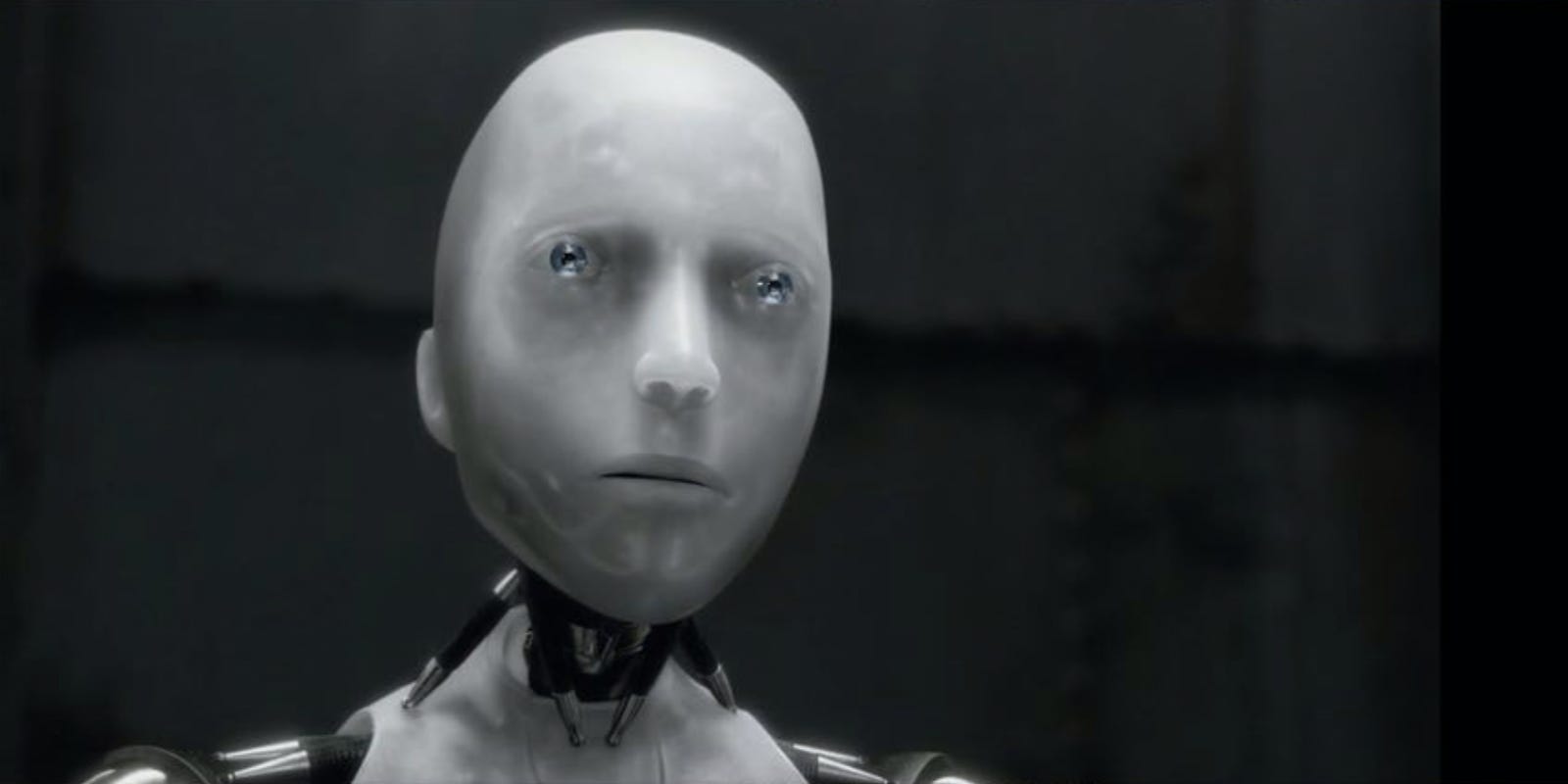
And honestly, I felt alittle Will Smith:
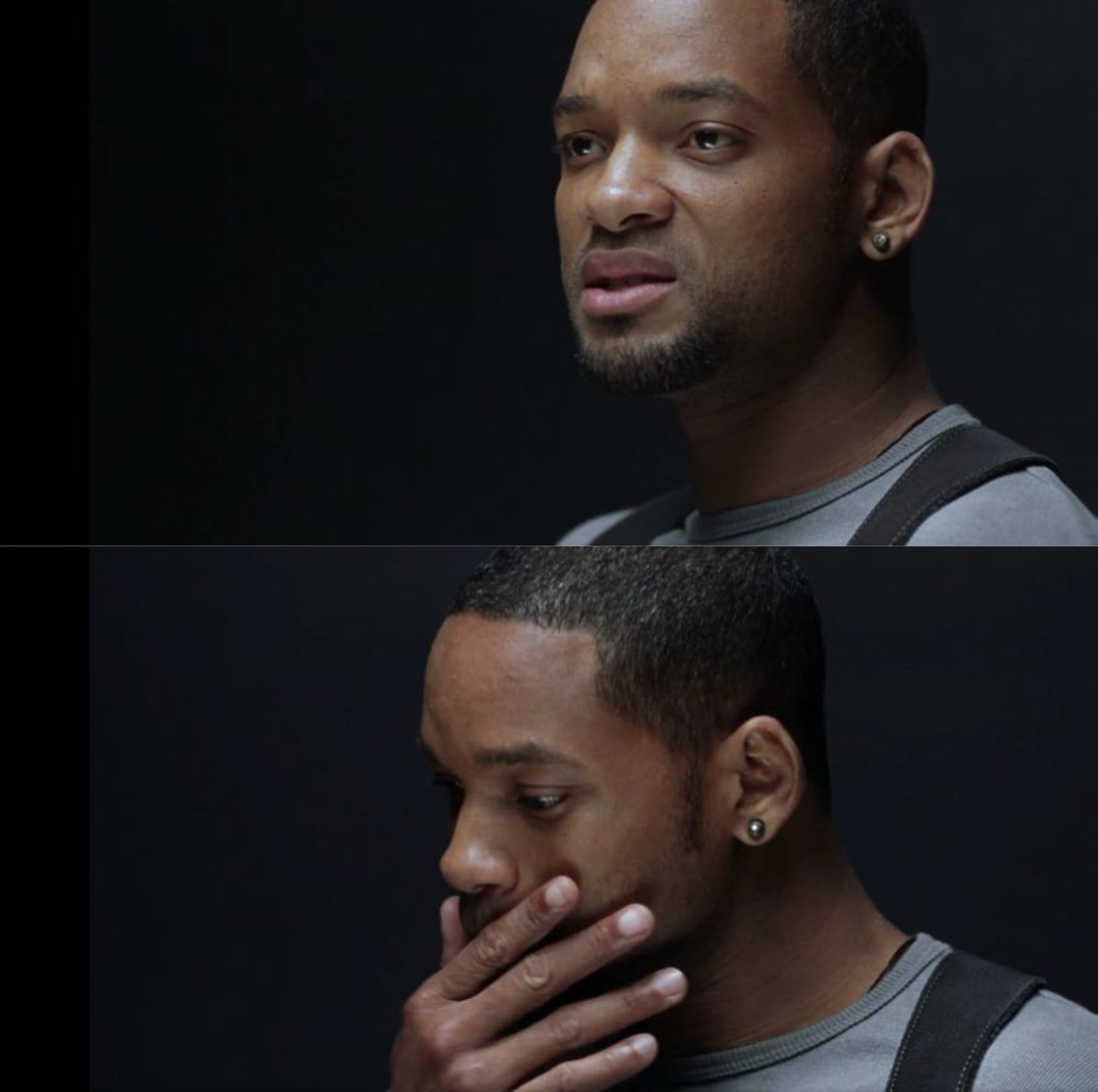
I was slightly shaken.
I’m usually a proponent of what AI tooling is set to unlock. I previously wrote about The Arc of Accessibility, and how so many great consumer products got massive by empowering individuals to create in new and previously unseen ways. With music specifically, Ableton allowed a teen to create Grammy-caliber tracks in his bedroom and the internet enabled him to distribute that music infinitely. An incredible unlock for all of our earballs.
So, now I’m sitting here asking myself, “Well, if it was an individual leveraging AI tools to make more, better, and different music than they ever could have otherwise, that’s pretty sweet. More creativity in the world, and more tracks that I love!”
But if it was just end-to-end AI production generated en masse…
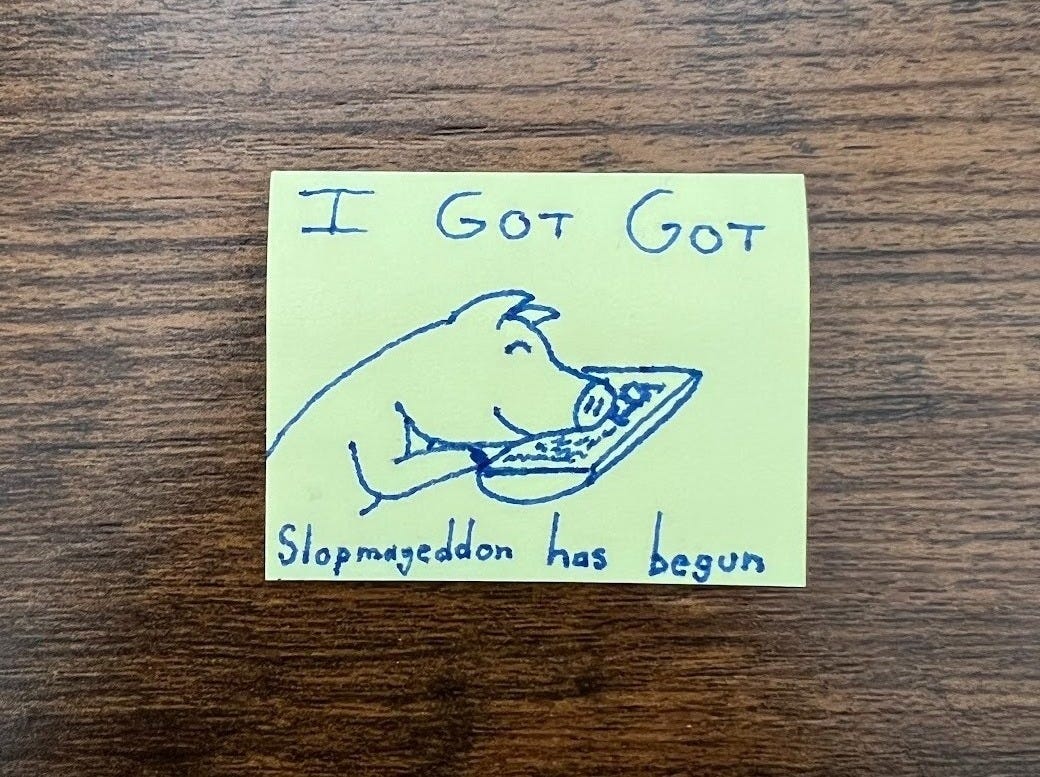
Well, shit. Now, I’m left wondering if I’m just another little piggy at the AI slop trough:
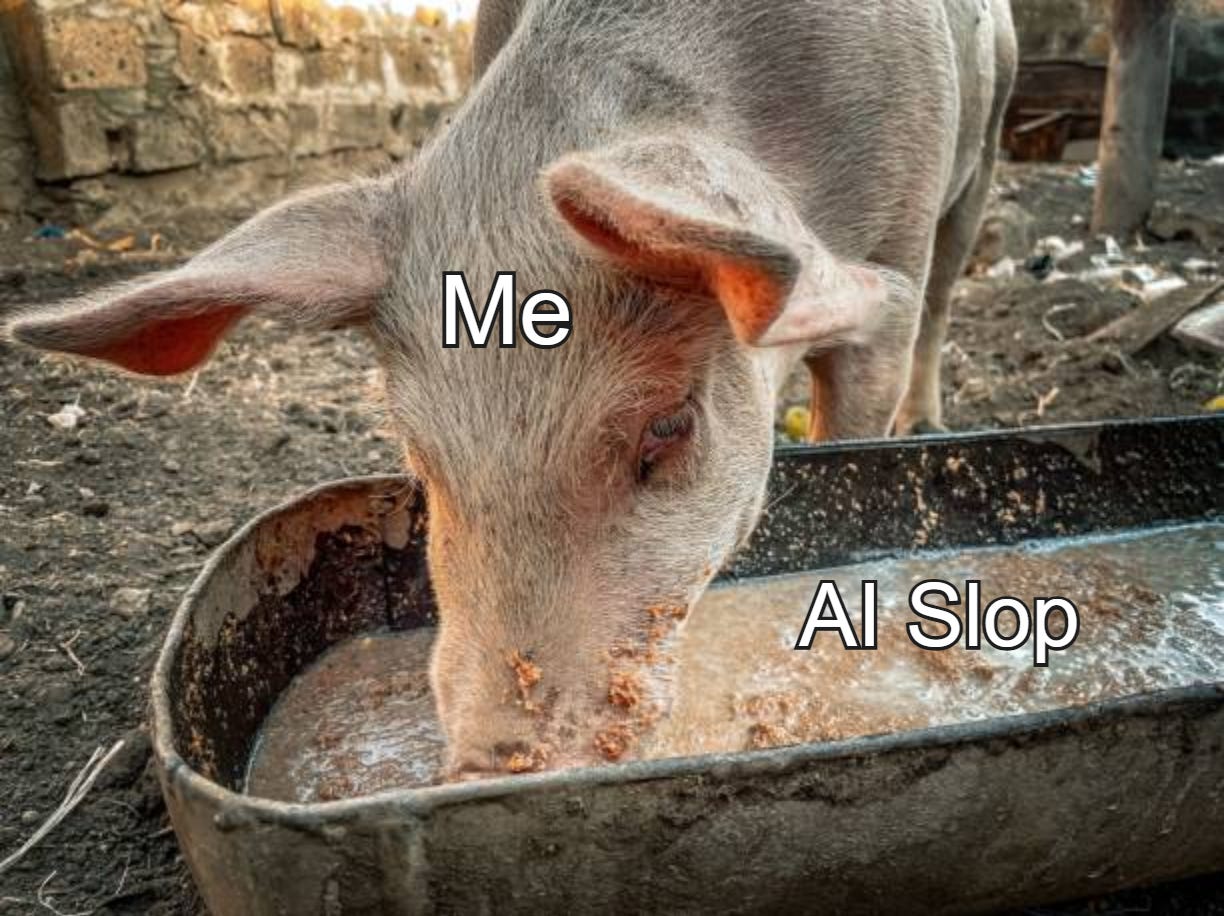
Because what does this mean for the future of music? For the future of art?
If these songs still evoke emotion in me, then what? Is it still slop?
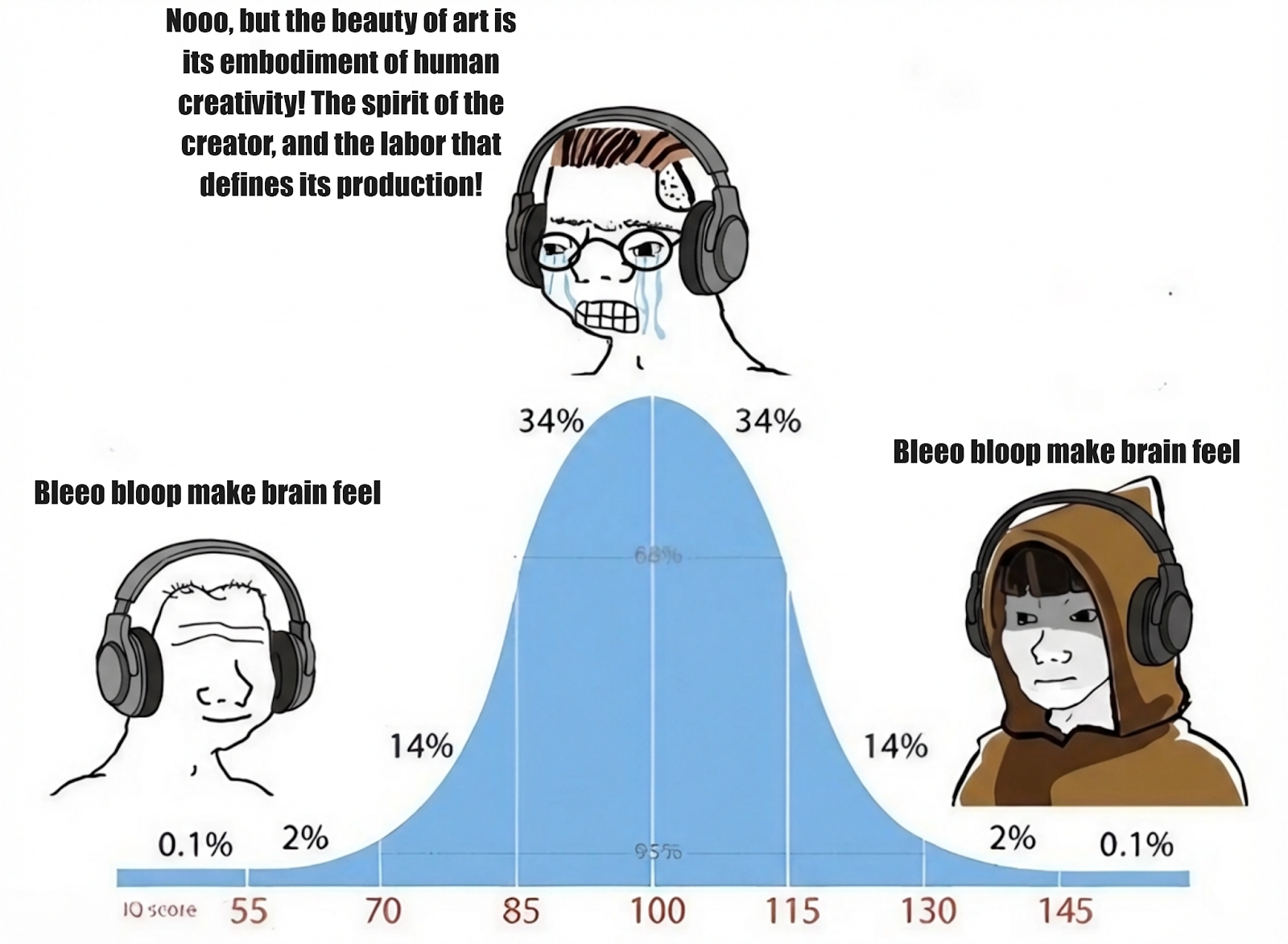
I honestly can’t tell if this curve is correct or if it should be precisely the inverse. Perhaps I’m a mouth breather eager to be supplicated by the cultural opiate of infinitely-produced entertainment. Or maybe the slop mania really is the implosion of culture as we know it.
Granted, these tracks I’m discussing are a very specific Wynn flavor of repetitive kinda background music that would be fairly easy to replicate with AI, but these tools are advancing exponentially and will not be constrained to more formulaic genres for long. We will see a top charting track, completely AI generated, within the next twelve months. Mark my confused words. This will precipitate all sorts of questions that we’ll collectively be grappling with over the coming months and years.
For example, how does this evolve the position of an artist? Does this amplify the value of curation? In a world where artists are capable of making any style of music, freed of genre and production limits, does that compound the extent to which we’re really just valuing an artist for their taste more than their craft?
When I go to see a DJ at Concourse Project here in Austin, even the headliners probably only play 70% of their own music in an hour and a half long set. Half of the value is the in-person experience, but there’s also an element of enjoying their taste and the upcoming artists that they surface. I appreciate when Disclosure includes a tune from some DJ with 10,000 listens; it reminds me of just how relentless the pros are in pursuing new sounds.
Maybe this is overintellectualizing. The biggest artists in the world already become more brand than human today. Drake and Taylor Swift have an entire stable of songwriters, ghost producers, support staff, etc. to help perpetuate the industrial music machines they represent.
Plus, this dynamic holds across most creative arenas.
You go to a Michelin-starred restaurant to experience the ideas and menus of its famous head chef, but it’s his or her understudies that are plating your overpriced pork shoulder. A famously controversial example of this in the art world is one Jeff Koons:
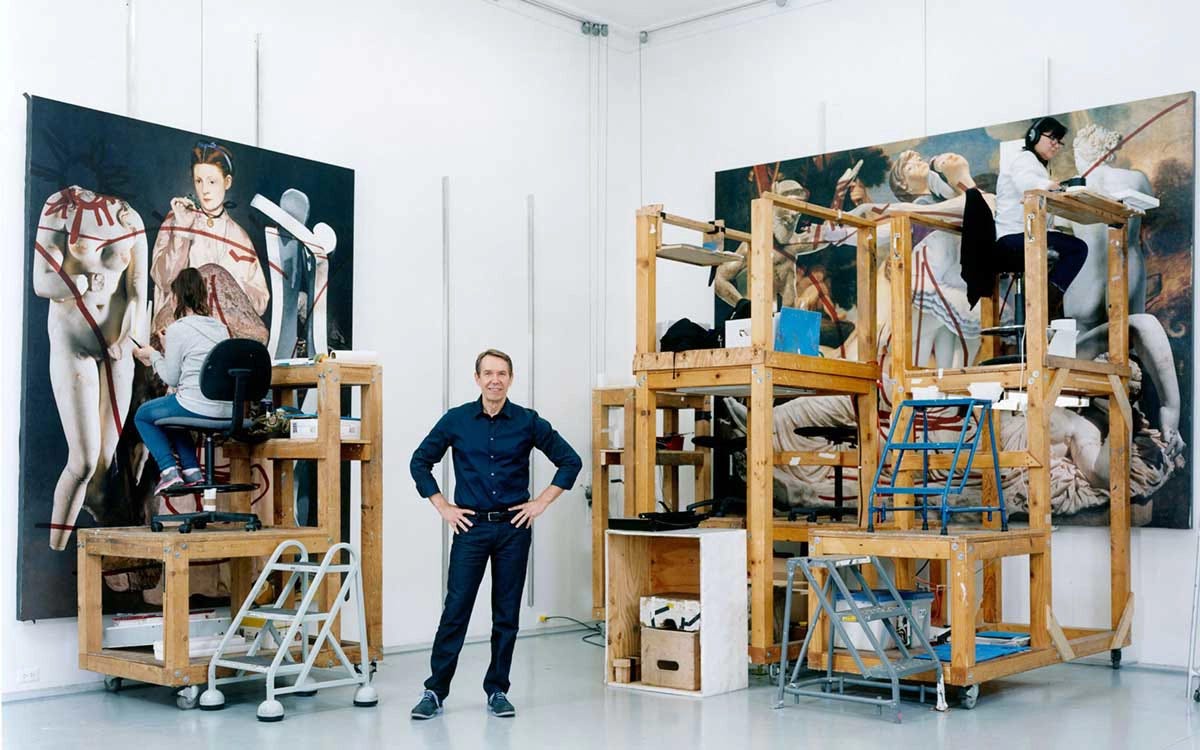
“After becoming an established artist, Jeff Koons went on to establish a busy workshop space in the Chelsea district of New York. Here he employs a team of over 100 highly skilled assistants who make his art for him… [He] often creates the designs for his artworks by using computer technology, building how he wants the work to look before handing these digital prototypes over to his studio assistants, or other specialists.” - Rosie Lesso, How Does Jeff Koons Make His Art
In our Brave New World, how much does it matter that those starving NYU grad students are replaced with AI? You were paying $5M for the brand on a piece that Jeff’s hand may never have physically touched anyway. AI is enabling a deluge of slop, yes, but perhaps the more things change the more they’re really staying the same. We will latch onto artists and personalities for their taste, regardless of whether the creative’s team is underpaid assistants or autonomous Clawdbots. The biggest creators in the world aren’t businessmen, they’re a business, man.
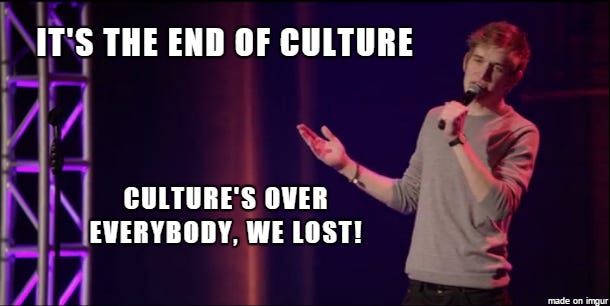
That said, I’m still wrestling with the synthetic nature of it, I suppose. At least Koons has a human in the loop somewhere to execute his vision. Creativity and taste were promised to be one of the sacred bastions that makes us human, and we’re seeing this facade begin to crack:
It’s creative output industrialized.
What comes next is going to get weird. I’m not entirely sure how this plays out from a consumption/production perspective (how many AI DJs will I inevitably add to my rotation?), but I do have initial thoughts for what remains evergreen in this cultural avalanche: exclusivity and belonging.
Abundance in anything (art, music, etc.) will continue to drive value to that which is scarce. This cultural shift may create a space for more bespoke output– proof of humanity or tracks inclusive of the little bumps and imperfections that come with unprocessed creation. Perhaps, more live albums. But I think that is less likely to be the major change in music simply because widespread distribution is so key for an artist’s success. For example, it’s great that Wu Tang released a single print $2M Gold Album, except that no one ever listened to it besides like five crypto bros and Martin Shkreli.
Where I do see value expanding is IRL. As digital channels get flooded, the premium on in-person events should continue to accrue. Concerts, VIP, backstage, after parties - these are all events with limited space and fleeting availability. The more lux experiences are defined by exclusivity, but the broader access is defined by community. The latter aligns fans with others who enjoy their favorite artist. It leverages moments that can bring people together through shared and aligning interests, which should only gain value in a world plagued by metaversal loneliness.
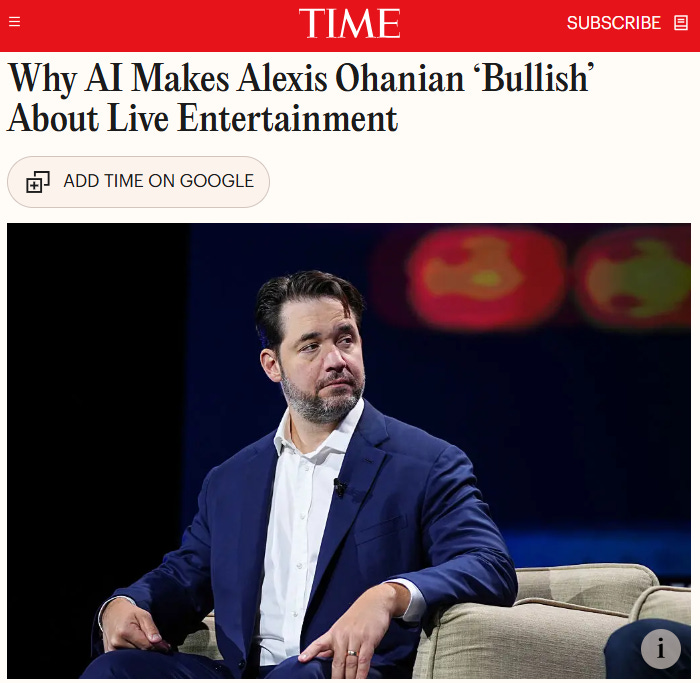
I’m not the only one speculating on this thesis. There’s a great deal of money changing hands as billionaires and tech titans scramble to invest in everything from live sporting events to theater. There’s a very specific reason that the NFL is able to command so much for its broadcasting rights; live, human sport is generated in real time and unmediated by layers of slop. Reminiscing about your favorite teams still stands as one of the simplest in group / out group activities around half of America’s water coolers, and ‘catching the game last night’ generates weekly drama for its followers. Similar ideas could also explain the virality of events like Austin’s Morning Spins, and the broader wave of coffee shop DJ popups that have gained so much popularity with millennials. It’s something to do together, cultivating some modicum of community, limited by space, time, and capacity. In cyberspace, something like Twitch may occupy a more valuable niche with its primary focus on livestreaming.
Furthermore, IRL events may gain an additional premium as our virtual world continues to splinter. The internet democratized fame as it unlocked the long tail for a generation of creators. Suddenly, micro celebrity was possible and hyper niche creators could leverage social networks with infinitely larger addressable audiences to connect with their 1,000 true fans. That accessibility of culture fragmented our collective experience – your algorithm differs from my algorithm in our mediated consumption of the web. A great example of these cracks is streaming, where networks used to be able to produce monolithic hits that would capture our collective conscience (ex: The Sopranos, The Wire era) in a way that simply doesn’t exist within the multi-platform streaming wars (Apple’s Severance vs. Netflix’s Stranger Things vs. Hulu’s The Bear). AI is poised to accelerate this phenomenon as content will be increasingly hyper-personalized and algorithms will now be pitting infinitely produced AI creation against limited pools of human eyes.
The battle for our attention is as fierce as it’s ever been, and the insurgency of artificial contenders is set to intensify it. Today, video games compete with streaming competes with short form for the precious remaining hours of your life. Tomorrow, agentic apps, generative media, and AI-native hardware will enter the arena. The Slop Wars have arrived, and it’s an open question as to what exactly the collateral damage will be. I’m sure my playlists will continue to accrue beats brewed in the alchemy of algorithms, but maybe I’ll just be in hog heaven.
Anyway, here’s my sister’s reaction:

- 🍋
I got a little meme heavy this week.. My favorite Angel investment, Memelord.com just launched their newest version + mobile app, and it absolutely rocks. So snappy, so clean. If you’re in the marketing, or laughing, game… check it.